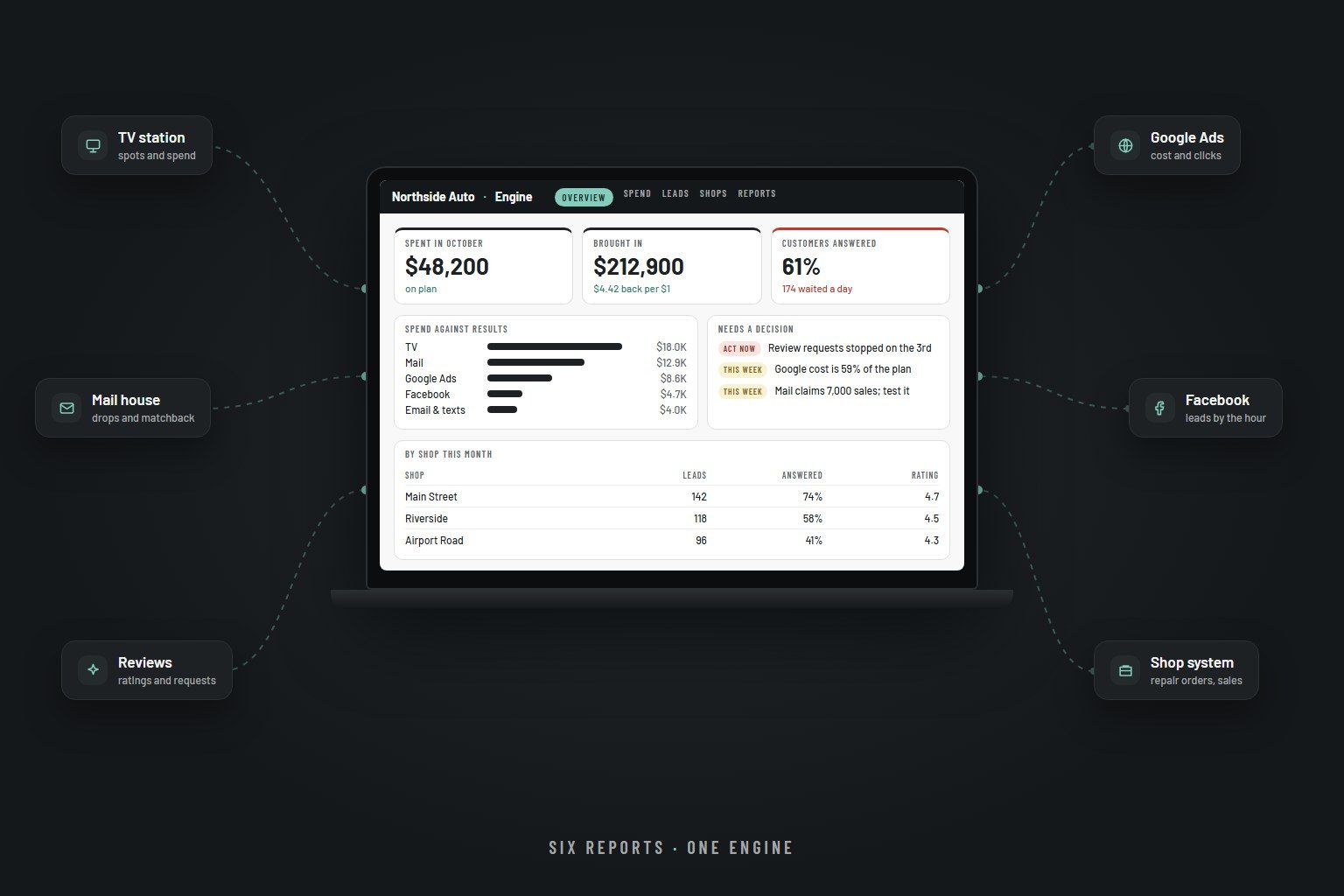
A business we work with pays five companies to report on its marketing: the TV station, the mail house, Google, Facebook and the review platform. Each one sends a report, and each report says it’s working.
Side by side, the reports told a different story. The email platform credited a sale to every message the customer had received in the month before it, so one repair order could be counted five times over. The review platform was still receiving the shop system’s daily file, but it had quietly stopped recording repair orders from it five weeks earlier, and the review requests that depend on those orders had stopped with it. The search ads, run from the TV station’s own Google account, were buying website visits that lasted seven seconds.
Nobody was hiding anything. Every one of those reports was accurate on its own terms, and each sat in its own login. It was simply nobody’s job to read them against each other. That is the job we built the engine to do.
What an engine is.
An engine is a private dashboard, on your own web address, built around the way your business makes money. Ours run a sixteen-shop auto repair company’s marketing and a home builder’s books, listings and leads, and the job is the same in both. It doesn’t replace the tools you already pay for. It sits on top of them.
- It reads what you already have. Your ad accounts, your website, your review platform, your phone and text inbox and your sales system, every morning or every hour.
- It checks one number against another. A vendor’s report against Google’s own figures, a platform’s revenue against your actual sales, this month against the same month last year.
- It shows money, not activity. What each channel cost, what it brought in, and which location it brought it to.
- It runs the routine, with your yes. Leads answered in minutes, reports on schedule, drafts ready to approve. Nothing goes out without you.
What it isn’t.
- Another login to check every day. If it only works when somebody remembers to open it, it doesn’t work.
- A wall of charts. Forty graphs is decoration. The question is always the same: where did the money go, and what came back?
- AI making decisions for you. It reads, adds up, drafts and flags. You decide.
- A reason to switch software. The point is to make what you already pay for answer to each other.
What one does on a Monday morning.
Here is the start of the week for the engines we run, before anyone in the business is at a desk.
- Overnight, it reads. Every ad account, the website’s visits and forms, the review platform, the phone and text inbox and the sales system, each on its own schedule.
- By six, it has added up. Spend against results for every channel and every location, last week against the week before, this month against the same month last year.
- Then it flags. Anything that moved more than it should: a channel that went quiet, a cost that jumped, a vendor’s number that doesn’t match the platform’s own.
- It drafts. The week’s findings in plain English, replies to new leads, the posts and emails on the calendar, each one waiting for a yes.
- And it answers. Ask which location got the most calls from Facebook last month, and it answers in a sentence, with the figures it used.
None of that replaces judgment. It replaces the three hours a week somebody would need just to collect the numbers before any judgment could start, which in most businesses means it never happens at all. The engine does the collecting and the adding up. The owner gets the part only an owner can do.
One page, once a month.
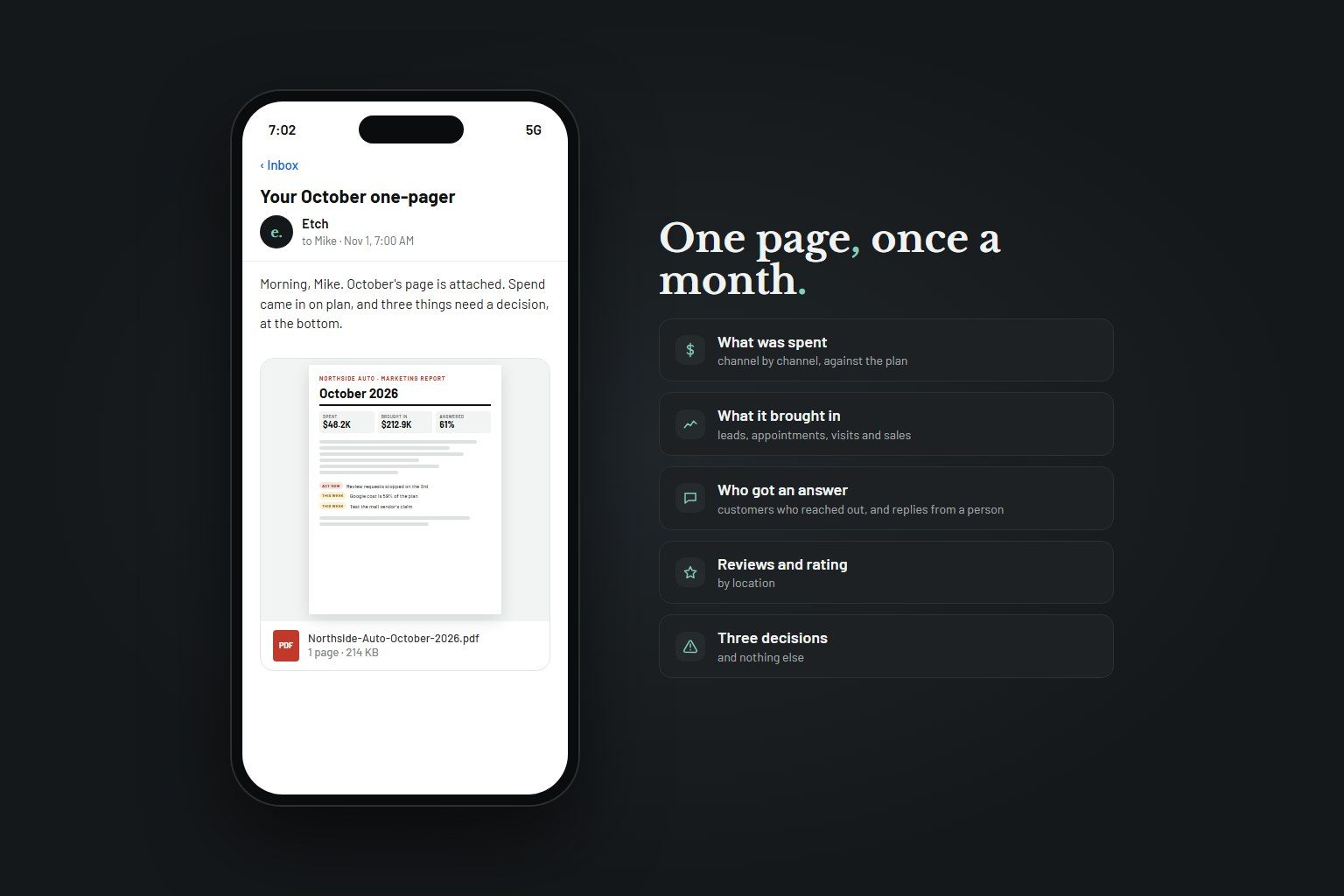
Here is the part most dashboards get wrong. The owners we work with will never log into one, and they shouldn’t have to. They run shops, crews and payrolls. So every engine we build makes one page for the month, as a PDF they can read on their phone or print for the office.
- What was spent, channel by channel, against the plan.
- What it brought in, from leads and appointments to visits and sales, as far as each channel can be traced.
- How many customers reached out, and how many got an answer from a person.
- New reviews and the rating, by location.
- The three things that need a decision this month, and nothing else.
Every number on the page ties back to the dashboard. When the owner points at one and asks where it came from, the answer is one click away instead of a week of emails.
One page is a discipline, not a limit. If something doesn’t fit, it usually isn’t a decision yet. The detail is in the dashboard for anyone who wants it. The page is for the person who signs the checks, and it is usually where the first real budget conversation starts.
Does your business need one?
Probably, if three or more of these are true:
- You spend marketing money in more than three places.
- You have more than one location.
- Your vendors report their own results.
- Reports arrive in five inboxes, and nobody puts them side by side.
- Nobody can say in one sentence what last month’s marketing brought in.
When you don’t need one.
If you run one location and spend on Facebook alone, you probably don’t. A good spreadsheet and a monthly hour will do. We’d rather tell you that than sell you something you’ll stop opening.
The arithmetic changes with size. A business spending $300,000 a year on marketing that moves a tenth of it from what isn’t working to what is has put $30,000 to better use, every year, without spending a dollar more.
Four questions for anyone who offers to build one.
- Where do the numbers live? On your own web address. You should be able to leave with them.
- Who sees customer data? The best answer is nobody. Phone numbers and emails should be matched inside the system and never shown in a report.
- What can it send alone? Nothing a customer sees. Drafts, flags and numbers, yes. Sends, no.
- What if a source breaks? You hear about it that week. A dashboard that keeps showing last month’s numbers as if they were today’s is worse than none.
How one starts.
Every engine starts the same way, and it’s useful well before it’s finished. The Engine page has the details, and the story of what one found in its first weeks.
- Month one, build. We map the systems you already pay for, connect them and build the dashboard on your own web address.
- Month two, shadow. It runs beside the way you work today. You check its numbers against your own, and we fix whatever doesn’t match.
- Month three, live. Approvals move into it, the monthly page starts arriving, and your team learns the two or three screens they’ll actually use.