The Engine For builders
The Etch Engine, for builders.
One login, every room a spec builder opens in a morning: the schedule that texts your crews, the plan on the sub’s phone, the money, the books, the market, the listing photos, and the marketing desk that sells the homes while you build them. It lives at your own address. Every send waits for your yes. It was built by a builder, and it runs his own company today.
Seven rooms. One engine.
Seven minutes and eighteen seconds, on Ryan’s desk
Watch it run.
Ryan builds spec homes in Dickson County. This is the desk that runs the company, filmed room by room on his own dashboard: the schedule texting the subs, the plan on the framer’s phone, interest carry ticking by the day, the books, the county and the lots, the listing photos, and the marketing that goes out while he is on a site. The film is the demo. The ask is one line at the end.
Jump to a room
Nothing on screen is a mock-up; it is the dashboard running, and the copy on screen is what it wrote. Four of the seven rooms in the film run on a demo company, Harper Ridge Homes: Ryan’s own dashboard with every name and number changed, because a builder’s crews, money and books are his own business. The plans run on Ryan’s own plan library with a demo job in it. The Studio and the marketing desk are his real desk, and the county numbers are real. The music is Ryan’s own.
Or skip the film: every room is written out on this page, each with its own chapter, and how it is priced and who it fits is near the end.
The desk before
You already have a marketing department. It is you, after dark.
A spec builder’s desk is a second job nobody applied for. The website lead arrives at seven in the morning and gets answered the next day, if the day allows. The framer needs to know Monday is still on; the lumber needs ordering by Friday; the agents who have shown your homes should hear from you every month, and they hear when you remember. The lender’s test lives in a spreadsheet you rebuild at eleven at night. And all of it competes with the actual work of putting up houses.
The usual answers are a project-management subscription built for a custom builder with a client to keep happy, a marketing hire the size of a superintendent’s salary, or an agency retainer that still needs somebody inside the company feeding it. We built the fourth answer because we needed it ourselves: one desk, seven rooms, on your own domain.
Why it exists
From the builder who needed it.

I ran twenty-one construction loans out of a spreadsheet and learned what they cost me one statement at a time. The marketing was worse. Four hundred agents who should have heard from me every month heard when I remembered, and a lead that came in at seven got a call at four.
I built this so I would know at six in the morning, and so the email would go out whether I remembered or not. It has run Southaven since the summer of 2026. Southaven is the builder I am. Etch is the company my wife and I run. This is the first thing we have sold that we had already bought ourselves.
Ryan Decker · Southaven Homes, Dickson County · Etch
Seven rooms
Everything, in one place.
The seven rooms below are the real desk. Five of them run on a demo company, Harper Ridge Homes: Ryan’s own dashboard with every name and number changed, because a builder’s crews, plans and money are his own business. The other two are his real desk.
Room one · the crews
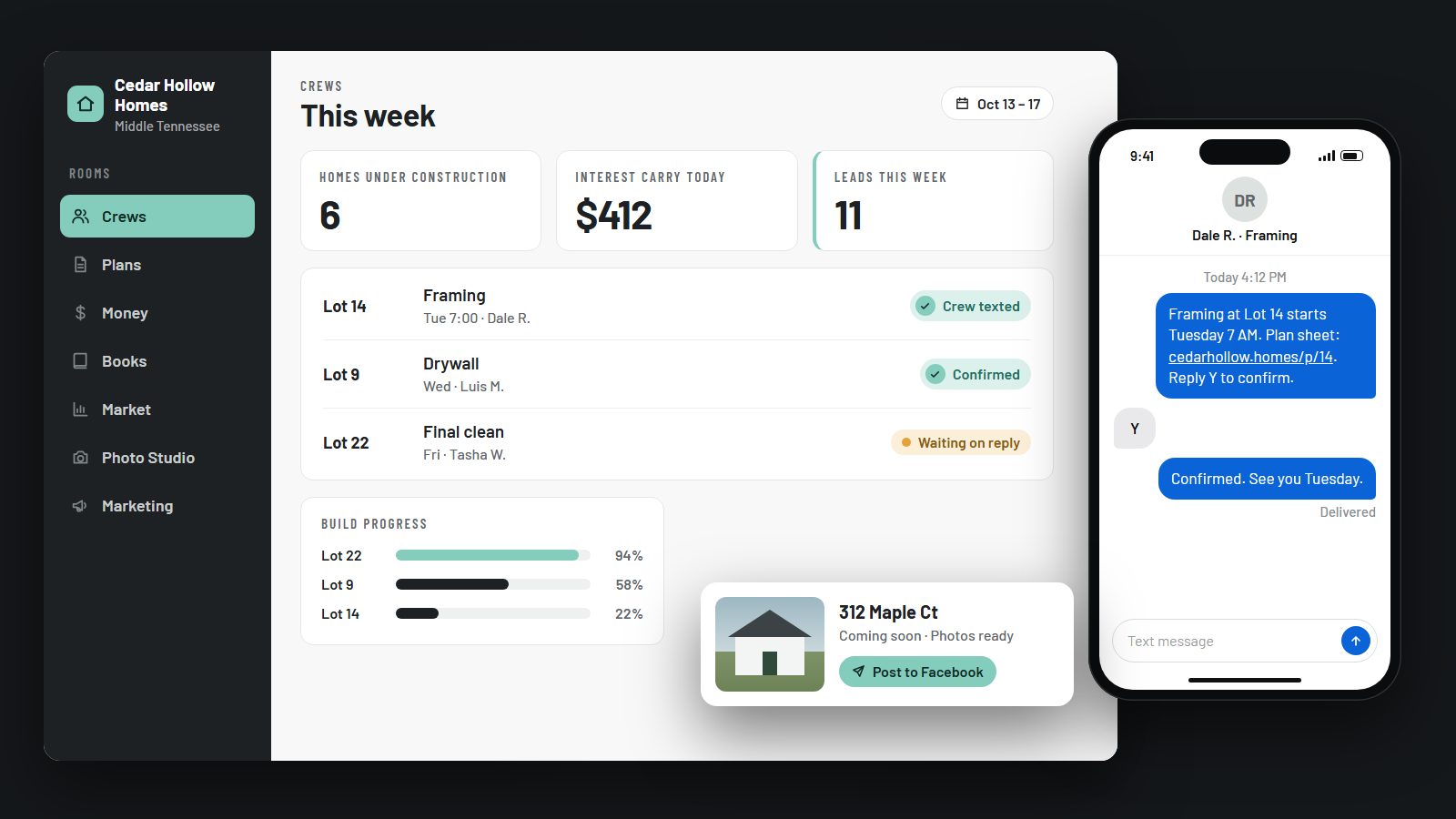
The schedule texts the subs. The replies move the schedule.
Every job, phase by phase, each task knowing which one comes after it. Three days out, the desk drafts the confirmation in the sub’s own language. “Wednesday works” comes back, gets read, and turns into a proposed move with everything downstream listed. You tap once.
- Seven days out, three days out, the day before: each asks for a YES. One YES stops the reminders. On the finish date it asks “did you finish?”
- English or Spanish per contractor, set once on the roster. Replies come back with a translation beside the original.
- Supplier orders go out by email with the plan sheet attached, dated from lead times. A reply marks them ordered.
- Anything about money, materials or selections is flagged for a person, never guessed at. Per job the crew texts run one of three ways: off, you approve each one, or automatic, which sends only the reminders you approved once, word for word. Anything drafted or decided still waits for a yes, and marketing never has an automatic setting.
Room two · the plans
The job on the sub’s phone, from one link.
Every plan in the library with its drawing set, its takeoff and its config. Every job is that plan plus the selections you picked for that house: exterior, interior paint, flooring, kitchen and baths, lighting. The framer gets a link, no login, that opens the plan, his trade’s takeoff and those selections. The supplier gets the same for his trade. If a crew has a question about that job, a box on the link answers it from the job’s own spec, and nothing else.
- The library: each plan with its drawing set PDF, its takeoff spreadsheet and its config; a job package PDF and a printable QR code per job.
- Per job, the plan plus that home’s selections, yours to choose; there is no client portal here.
- Field links for crews: a link with no account that opens the plan, that trade’s takeoff and the selections. Suppliers get a per-trade page with the takeoff. Job documents upload per job and stay with it.
- The question box on that link reads this job’s spec back to the crew. It is the one thing on the desk that answers back, and it decides nothing, sends nothing and orders nothing. If the spec does not say, it says so.
Room three · the money
The math the project-management tools don’t do.
They track the job. This tracks the deal the job sits inside: what today’s carry is, whether the next lot is a go, where cash sits in week eight, and what every home actually made against what you thought it would.
- Interest carry from the first dollar, per loan, ticking by the day, modeled the way your lender charges it.
- The lender’s capacity test walked through every closing on the board, and draw gates tracked against real spend so an earned draw never sits.
- A P&L for every job: expected sale, cost basis, projected profit, margin, carry per day, your cash in the deal. Closed homes score their own targets.
- A cash line 13 to 52 weeks out with the low point named, and a closing checklist read out of the executed contract.
Room four · the books
What each home made, and whether you are building faster than you sell.
The company’s numbers, read from QuickBooks once a month and never typed: revenue, cost, profit and margin for the period; cash, receivables, debt and equity; a P&L by entity if you run more than one. Then what the books alone do not show: what a home actually earned, read from the closed jobs of the last twelve months, build pace against sales pace, and what is coming in the backlog.
- The KPI row and the balance-sheet row, monthly, from the books.
- P&L by entity, chart and table. The consolidated column is a plain sum; intercompany is not eliminated, and the page says so.
- Unit economics from the closed-job records: profit and margin per home over the last twelve months. Absorption: your build pace against your sales pace. Backlog: what is coming.
- Per-job P&L stays in the money room; this is the company above it. QuickBooks is read, never written, and nothing from it is sent to an AI model.
Room five · the market
Know the county before you buy the lot.
Rates, inventory, days on market, price per foot and lumber, refreshed every morning from public sources, then read against your own listings in a brief every Monday. Every lot you have looked at goes on one map with the homes you have built, scored for whether this plan makes money on this lot at this price.
- The Monday brief, written for your listings: what changed this week and what it means for your starts.
- The Land Room: lots from your MLS alerts and the scouts, on a map, each with a go/no-go and a max lot price.
- The Bid Room: the build priced against what your own closed homes actually cost, plan by plan, before you commit.
And then the two rooms that sell the houses.
Room six · the Photo Studio
Listing photos, finished to one standard.
Three presets, locked, so every photo comes out looking like yours. Polish keeps every appliance, fixture and finish exactly as photographed. Exterior turns the seeded yard into a lawn and puts the sky back. Staging furnishes the empty room in your style and leaves the room itself untouched.
- Thirty seconds a photo, pennies each. No retouching bill and no waiting on a photographer’s edit.
- A before-and-after slider on every result, and a re-run with a note if you want it different.
- The rules live in the preset, not in a prompt somebody has to remember to type.
Room seven · the marketing desk
Sells the homes while you build them.
The agent email drafted from this month’s live listings, five subject lines and three angles, waiting for your edit. Listing copy written from the home’s real specs. Posts previewed the way Facebook and Instagram will show them, with a Fair Housing screen before anything is queued. A blog on its own calendar. All of it on your domain, up before you are.
- Two lists, two voices: agents get the numbers, buyers get the homes. Never one blast.
- The listing writer: MLS description, agent text, just-listed post, price-improvement note, open-house invitation, from the home’s real specs.
- The social composer flags any listed home with no post in two weeks, so nothing goes quiet.
- The website, if you need one: floor plans, live listings, a blog, forms that feed the desk and text the lead back in minutes, with the reply you approved once.
The numbers
What Ryan’s dashboard says.
From the Southaven Homes dashboard, September 2026. The Engine has run the desk since summer 2026.
The open rates are good, but they are not the point. The point is that the emails exist: drafted from live inventory, edited by a person, sent on schedule, month after month, while the owner is on a job site. We will not print an industry benchmark here that we did not measure. Your own numbers are the comparison that matters; bring one and the twenty minutes start there.
The whole menu
Twenty screens, one login, laid out the way a builder’s week runs.
Take the marketing desk alone, or the whole thing; the rooms are added as you need them. Nothing on this list is a roadmap.
How it is built
Yours, on your address. AI where it saves an hour, a person where it spends money.
The honest part
How it is priced, and who it fits.
An Engine takes about three months to go live, because the first month is spent learning your business rather than automating it: your plans, your lots, your lender, your subs, your lists, your voice. What those months produce is your company loaded into a desk on your own domain. Two numbers: a build fee once, for those three months, then one monthly for running it. There is one pair for the marketing desk alone and one for the whole desk. We quote them rather than print them, and you get both numbers before any call: text Ryan at 615.894.9921. Builders skip the Growth Assessment; we have already run one on a builder. We run the Engine for a few companies at a time, because every one of them gets Jessica’s eyes on every proof and Ryan’s hands on the system.
- You build your own plans on your own lots and sell them. Spec, not custom.
- You carry somewhere between three and forty active jobs.
- You are in Middle Tennessee, or you do not mind that we are.
- You would rather approve a good draft than write a bad one at eleven at night.
- Custom builders and remodelers with a client to keep happy. Client portals, client selections and change orders are not what this is.
- Anyone who wants a chatbot on the website. We do not build them.
- A company that wants the machine to send without a person reading. That is the one rule we will not bend.
Questions builders ask
Straight answers.
What does it cost?
A build fee once, for the three months it takes to go live, then one monthly for running it. We quote it rather than print it. Text Ryan at 615.894.9921 and you will have both numbers in writing before any call.
Who else is running it?
Southaven Homes, Ryan’s own company, since the summer of 2026. You would be the second company on it, and the first that is not ours.
What do I have to do in month one?
Send what you already have: your plan PDFs, your loan terms the way your lender charges them, your sub roster with phone numbers and which ones text in Spanish, and your agent list if you have one. Ryan builds the rest and does the domain record with you on the setup call. A few hours of yours across the month, mostly answering questions.
Does my brother get in? My bookkeeper?
Everyone in the company who says yes to things gets their own login on their own phone. Ryan’s brother ticks the closing checklist from his; that is in the money film. Your subs never get a login.
Is the box on the crew’s plan link the chatbot you say you do not build?
No. The chatbot we refuse is one on your website talking to buyers. The box on a crew’s job link reads that job’s spec back to the crew and nothing else: it does not send, order or decide anything, and if the spec does not say, it says so.
Do I have to take the whole dashboard?
No. Some builders start with the marketing desk: the agent and buyer emails, the listing writer, the social composer, the blog and the Monday report. Some start with the crews and the money. The rooms are added as you need them.
Who writes the emails and the texts?
The Engine drafts them from your live listings, your schedule and this week’s market. A person approves every send: you, or Jessica at Etch if you would rather not touch it. Nothing goes out on its own.
How does ceo.mycompany.com work?
One CNAME record at your domain registrar points ceo.yourcompany.com at your private instance. We handle the certificate and do it with you on the setup call. About ten minutes.
Do my subs have to download anything?
No. Nobody on a crew ever makes an account. They get texts and reply to texts, in English or Spanish per contractor, and a link that opens the plan for their job. Suppliers get an email with the plans attached. Your side of it is one screen.
Does it replace QuickBooks?
No. It reads QuickBooks for job cost and financials and never writes to it. Your books stay where your bookkeeper wants them, and nothing from the books is ever sent to an AI model.
Who owns my data?
You do. Each company runs in its own private instance, backed up nightly, never pooled with anyone else’s. If you ever leave, you take it with you.
What happens after I send the form?
Ryan reads it himself and texts you two times that work, usually from a job site. Nothing automatic replies. If it cannot wait, text 615.894.9921.
Anything not answered here: text Ryan at 615.894.9921, builder to builder.
Twenty minutes
Walk the desk with Ryan.
Bring nothing. Ryan drives his own desk on a screen share: the real one for the marketing, the demo company for the crews and the money. If you want it on your numbers, bring the one thing you care about most, a listing, a loan statement, your sub roster, and he shows you what the desk would do with it this month. You leave knowing whether it fits. The two numbers come before the call, not after it.