Ask an owner where their marketing stands this morning and the honest answer takes five logins: the email platform, the ad account, the review site, the social scheduler and the inbox where leads land. By the time all five are checked, the morning is gone. And the thing that mattered most, the post that went out at nine with last month’s offer still on it, was never on any of those screens until it was too late.
None of those tools is the problem. Each one does its own job and reports on itself. What is missing is one place where the day’s work can be seen before it ships, and one rule that stops a mistake on its way out.
We run every client’s marketing, and our own, from one page like that. The film below is a minute’s walk through it. After it: what is on the page, the rule it enforces, and how to build a plain version of it this week with the tools you already pay for.
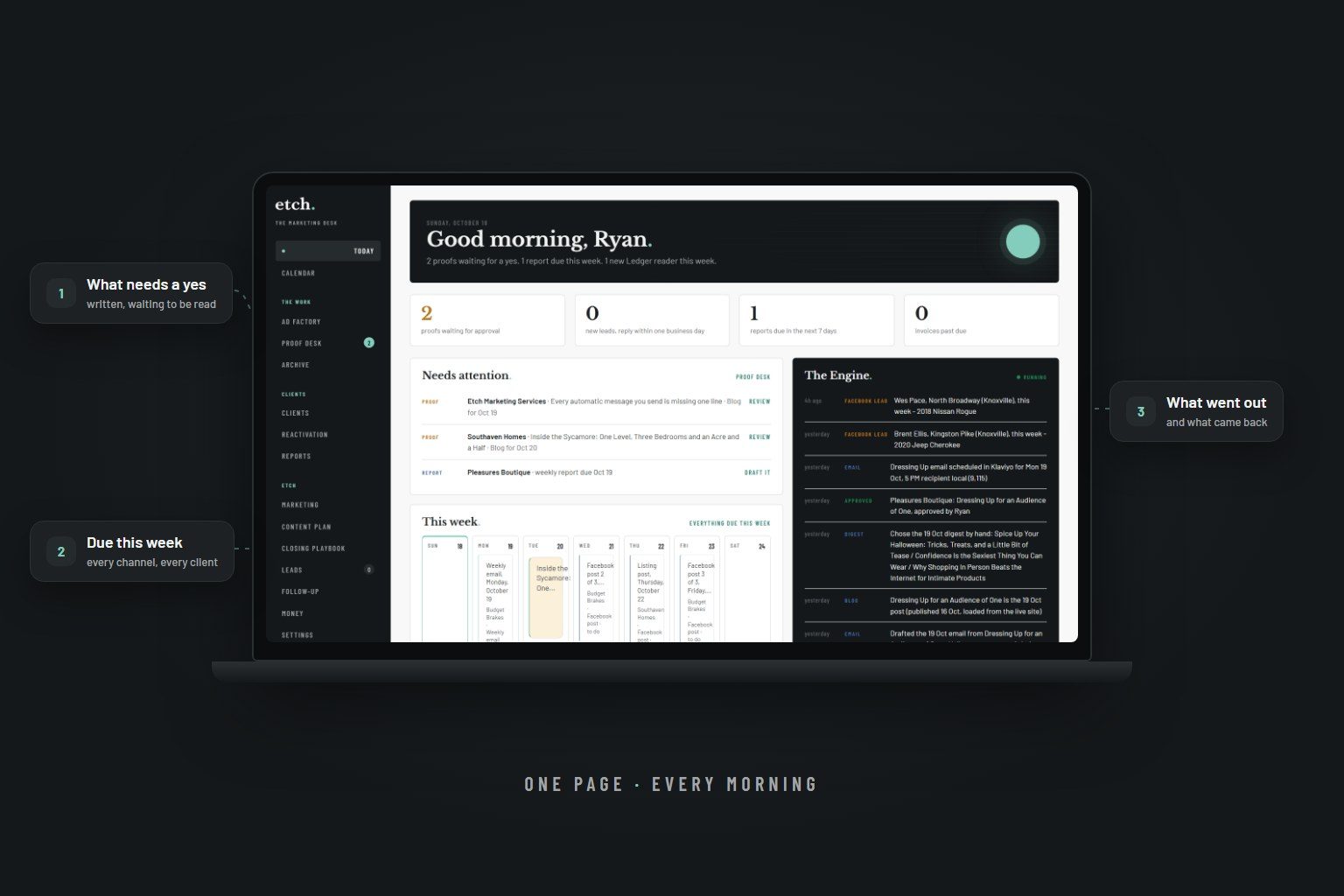
Three questions, every morning.
The page opens on three questions. Answer only these, in this order, and you will catch most of what goes wrong before a customer does.
- What needs a yes. Every email, post, ad and blog entry that is written and waiting for someone to read it, with the date it is due to go out.
- What is due this week. Everything scheduled across every channel for the next seven days, so a quiet week or a pile-up on Thursday is obvious on Monday.
- What went out, and what came back. A running list of what actually shipped, and the replies, leads and calls it produced.
Ours also flags any client that has gone two weeks without anything sent, because silence is the mistake nobody notices. On a single business’s desk the same flag works per location or per service line: if one of them has had nothing go out in fourteen days, it belongs on the page.
Put every channel on one calendar.
Most businesses keep a calendar per tool. The email platform has one, the social scheduler has another, and the print vendor sends a PDF. That is how a sale email and a full-price post land on the same morning.
One calendar for every channel and every location is the fix, and it can start as a shared spreadsheet with four columns: the date, the channel, what it is, and who has to say yes. Ours shows the month at a glance and opens any week as a list. The useful part is not the software. It is that every piece of marketing has exactly one row, so there is exactly one place to look.
Make the yes a step, not a habit.
Drafting is cheap now. A machine can write ten versions of an email before your coffee is finished, and that is genuinely useful. It also means mistakes can ship faster than they used to: a wrong price, a closed location, a coupon that expired last week.
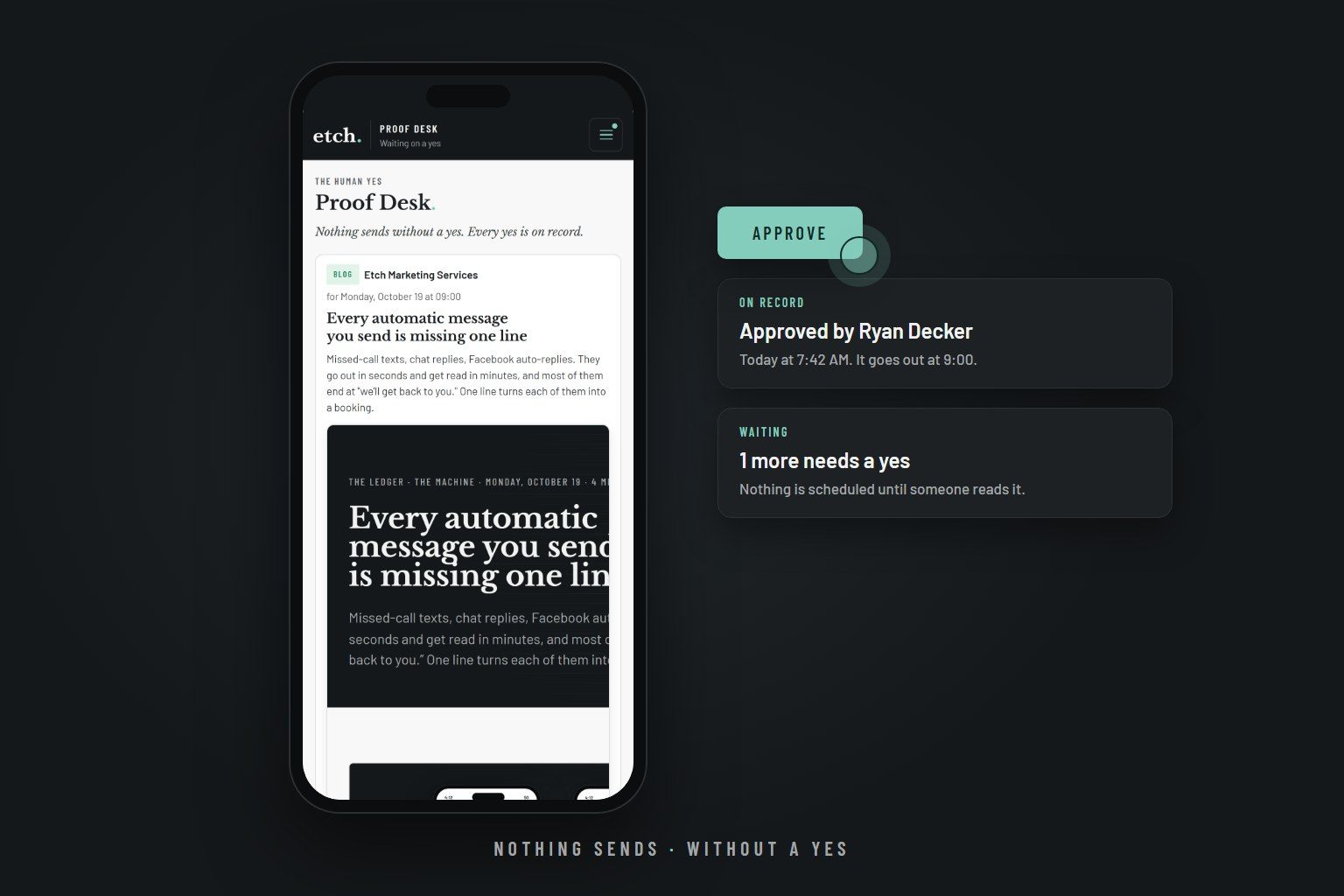
So on our desk nothing goes out until a person says yes. Every piece waits on what we call the Proof Desk, with a note on what was changed and why. One click approves it, and the approval is recorded with a name and a time. Nobody has to remember whether it was checked, because the record says so.
The note matters as much as the click. A draft that says what it changed from last week, which offer it carries and when that offer ends takes thirty seconds to check properly. A draft that arrives with no note gets skimmed, and skimming is how the wrong date gets through.
You can copy this without any software at all.
- One place for drafts. A shared folder, or a column on a board, called Waiting for a yes.
- Nothing gets scheduled from anywhere else. If a piece is not in that place, it does not go out.
- Write down who said yes, and when. A name and a date on the file or the card is enough.
Leads go on the same page as the work.
Marketing that brings in a lead nobody answers has cost money for nothing. So the same desk shows every new lead as it comes in: who it is, which location, what they asked about, and whether anyone has replied. For a sixteen-shop auto repair company we work with, that means every Facebook lead lands under its own shop within minutes, not in someone’s inbox on Monday.
If your leads arrive in three places, a website form, the phone and Facebook, the smallest fix is to send all three to one inbox or one sheet, and read it with the morning’s three questions.
Read your own numbers the same way.
Every Monday each client gets their numbers in plain English: what went out, what came back, and what we would change. We hold ourselves to the same page. Our own website traffic, where each visit came from and what it turned into, sits on the same desk and is read by the same people, with no separate report to forget about.
If you take one thing from this, take this: the numbers you read should be about the same work you approved, on the same page. When the approvals live in one place and the results in another, nobody connects them.
Start on Monday.
You do not need our dashboard to start. You need one hour and three decisions.
- List every place your marketing lives. Every login, every vendor and every inbox where a lead can land. Write it down; it is usually longer than you think.
- Make the one page. A sheet with the three questions as its tabs: waiting for a yes, due this week, went out and came back.
- Pick the rule. Nothing goes out unless it sat in Waiting for a yes and someone put their name on it.
Run it for a month and you will know which tools you actually use, which vendor reports you never read, and where the mistakes were coming from. If you would rather see what a desk like ours would look like for your business, the free checkup is the place to start: one page back, in two business days.