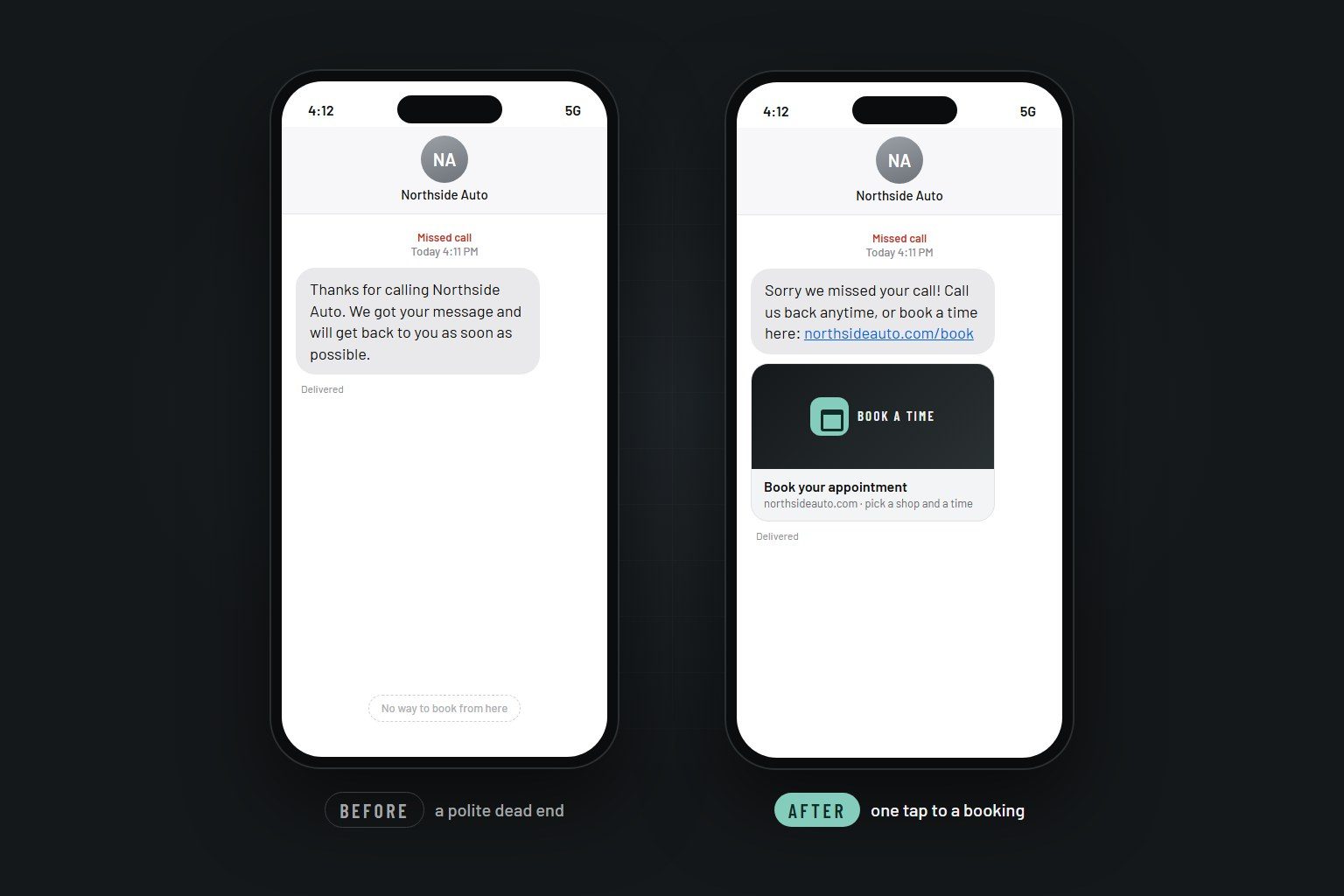
Last week we went through sixty days of customer messages for a sixteen-location auto repair business. 3,614 conversations. Customers had texted, called, chatted on the website and messaged on Facebook, and every one of them got an answer within seconds. Every answer was automatic, and almost none of them gave the customer a way to book. The website chat thanked 99 people and stopped there. Ten people who missed the shop on the phone wrote back to the text that followed; two of them heard anything after that.
The messages already going out.
Most businesses send more automatic messages than they realize. Someone set them up once, usually years ago, and they have been firing ever since without anyone reading them again.
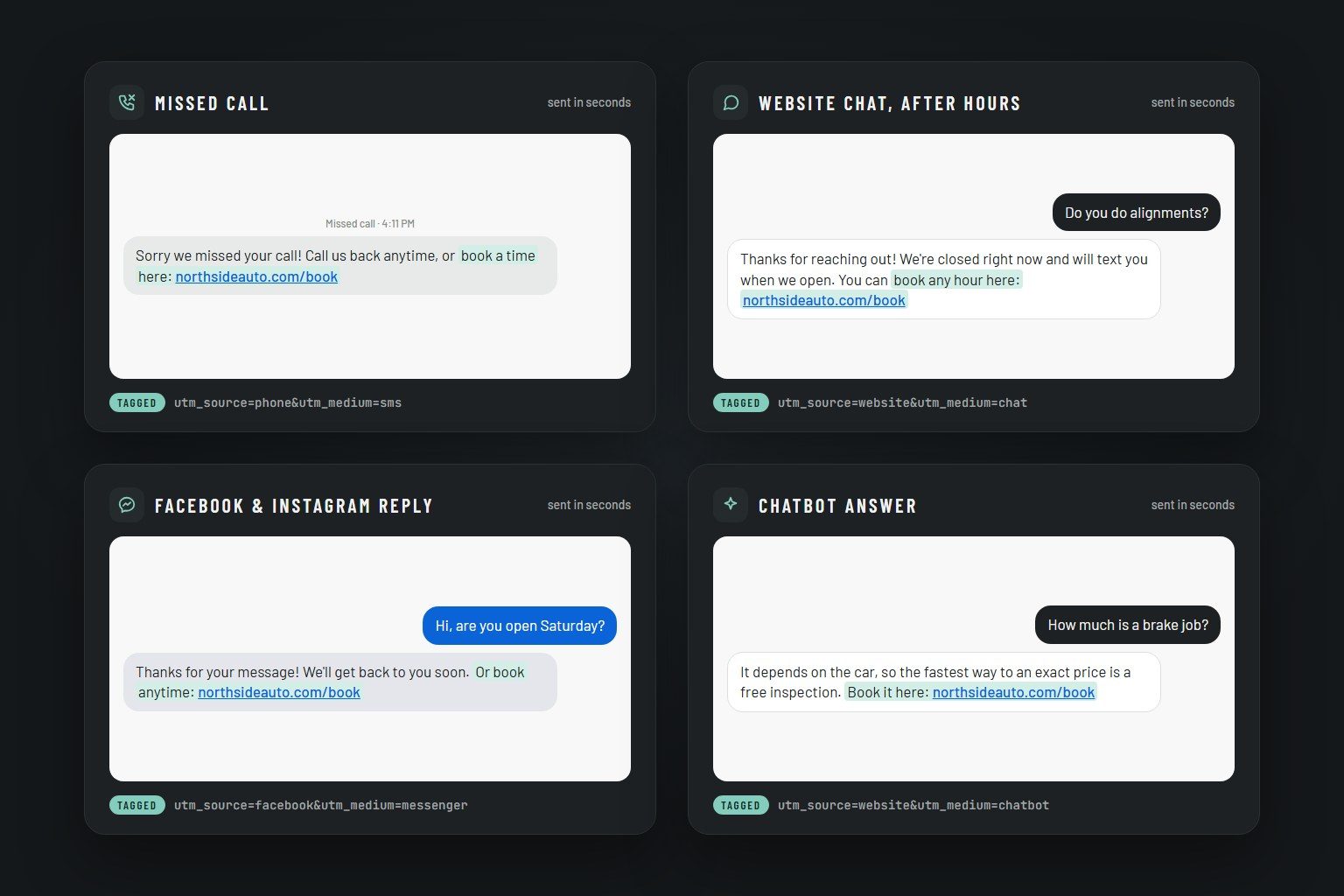
- The text after a missed call. Most phone systems and review platforms send one, often with a version for a caller who left a voicemail and one for a caller who didn’t.
- The website chat’s follow-up. Usually one for open hours and one for after hours.
- The Facebook and Instagram auto-reply. Set once in Meta’s inbox, sent to every first message.
- The chatbot’s answers, if you have one. Every answer it gives is a message too.
Each one goes to someone who reached out a moment ago and is still holding the phone. That is the best moment you will ever get with that customer, and most of these messages spend it saying “we’ll get back to you.”
The one line.
The fix is a single sentence at the end of each message: a link that goes straight to booking.
Before: “Thanks for contacting us! Someone will reach out shortly.”
After: “Thanks for contacting Northside Auto! We’ll text you back shortly. Want to skip the wait? Book a time here: northsideauto.com/book”
The customer who wanted to book, books, at eleven at night if that’s when they’re thinking about their brakes. The customer with a question still gets the call back. Nobody loses anything.
Four rules for the line.
- Straight to booking. Not the home page, not “visit our website.” One tap should land on a list of times.
- Tag the link. Give each message its own tag (a missed-call text might end utm_source=phone&utm_medium=sms) and your analytics will show which message booked which appointment.
- Promise only what happens. “We’ll text you back shortly” is fine if someone will. If nobody is watching the inbox yet, say “call us back anytime” and let the link do the work.
- Leave dates out. An automatic message lives for years. An offer with an end date goes stale the week it ends, and nobody remembers to change it.
Fifteen minutes, start to finish.
- Call your business from your cell phone, let it ring out, and read the text that comes back.
- Open your website’s chat after hours and send a question.
- Message your own Facebook page and your Instagram account.
- Add the line and a tagged link to every reply, in each tool’s settings.
- Do it all again from your phone, and tap every link.
We did this for the business above in one afternoon: nine new chatbot answers, both chat follow-ups, both missed-call texts, and the Facebook and Instagram auto-reply. We’ll come back with what it booked once a few weeks of tagged appointments are in.
What a link doesn’t fix.
A link isn’t an answer. A customer with a real question, a price, a noise, a time that isn’t on the calendar, still needs a person, or an assistant that can actually answer for you. In the same audit, hundreds of texts had waited days for a reply, and no link fixes that. Somebody has to own the inbox.
But the link starts working the minute you add it, it costs nothing, and it catches the customers who were ready to book while you sort out the rest. It may be the cheapest appointment you ever make.