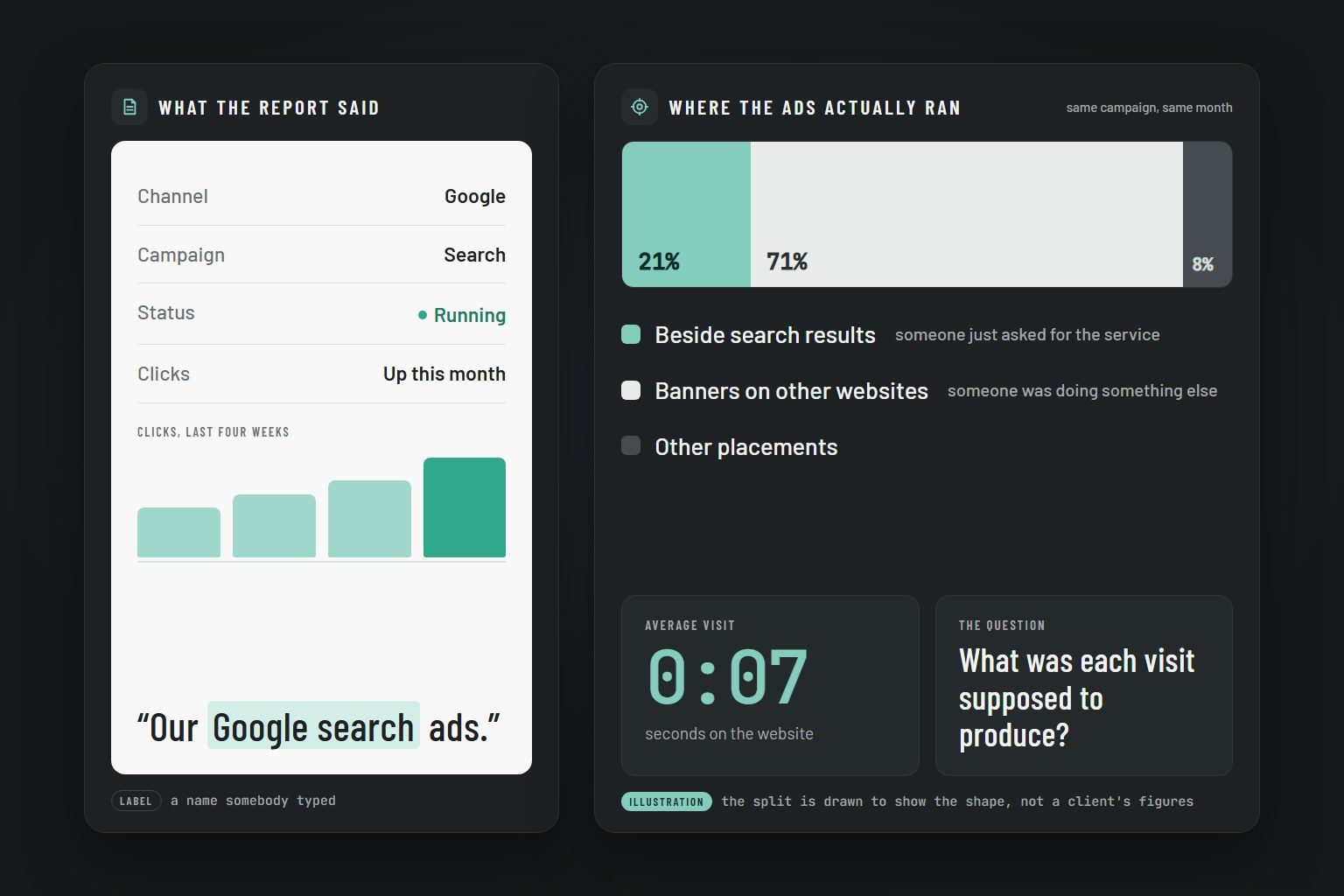
The business had several locations and a monthly marketing report. Google was on the report. The campaign was called search. Everyone understood that to mean the business appeared when someone nearby searched for the service it sold.
When we linked the account to the website’s analytics and looked at where the advertising actually ran, most of it was appearing as banner ads.
Nobody had hidden anything. The information was inside the account. It just had not made it into the conversation about whether the money was working.
The website visits averaged seven seconds. That number alone did not prove the campaign was worthless. It did give us a reason to ask a question nobody had asked clearly enough: what were these visits supposed to produce, and were they producing it?
Google is a company, not a placement.
“Google ads” tells you who received the money. It does not tell you where the customer saw the ad.
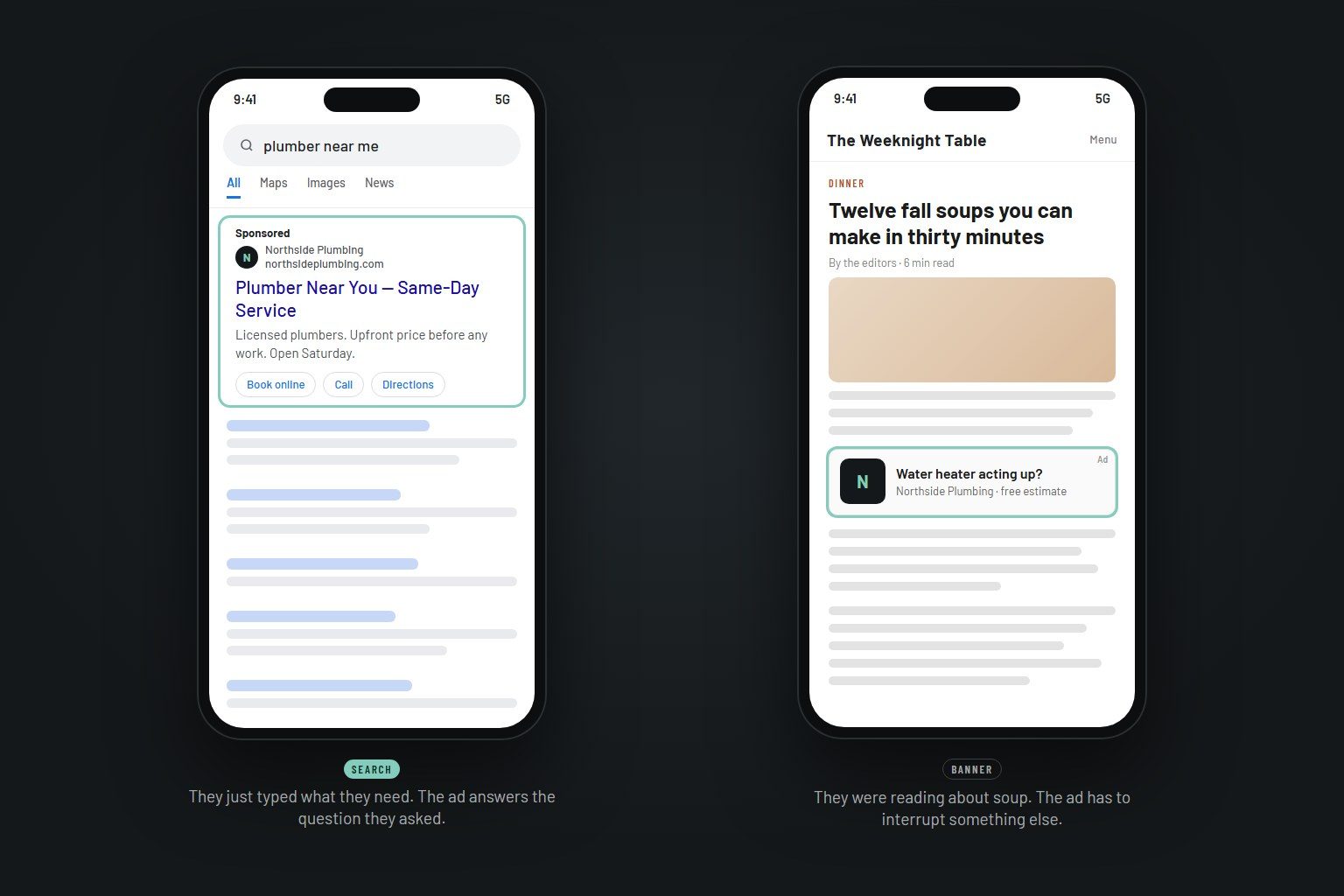
An ad beside a search result reaches someone who has just typed a question or a need. A banner on another website reaches someone doing something else. Both can have a job. They are different jobs, and the report should make the difference visible.
If you run a plumbing company, there is a difference between someone searching for a plumber near them and someone seeing your banner while reading an unrelated page. The second person may become a customer. The first has already told you what they are looking for.
The problem starts when those two visits are put in the same column and presented as the same purchase.
A campaign name is a label somebody typed. It is not evidence of where the money went.
Ask for the split.
Before you ask for new creative or a bigger budget, ask whoever runs the account for last month’s spending broken down by where the ads appeared.
Use this sentence:
“Show me how much we spent on search, display and any other placements, and what each produced in calls, forms and bookings.”
Ask them to open the account with you. You should be able to see the figures in the platform your business is paying.
Some campaigns distribute advertising across several places. Some reports give you more detail than others. Where the breakdown is incomplete, mark it incomplete. A limitation in the reporting is useful information; filling the gap with a confident summary is not.
Then ask three more questions:
- Was this the mix we agreed to buy?
- What job was each part meant to do?
- What result would make us keep paying for it?
Those questions are fair whether the campaign is working or not.
Follow the visit one step further.
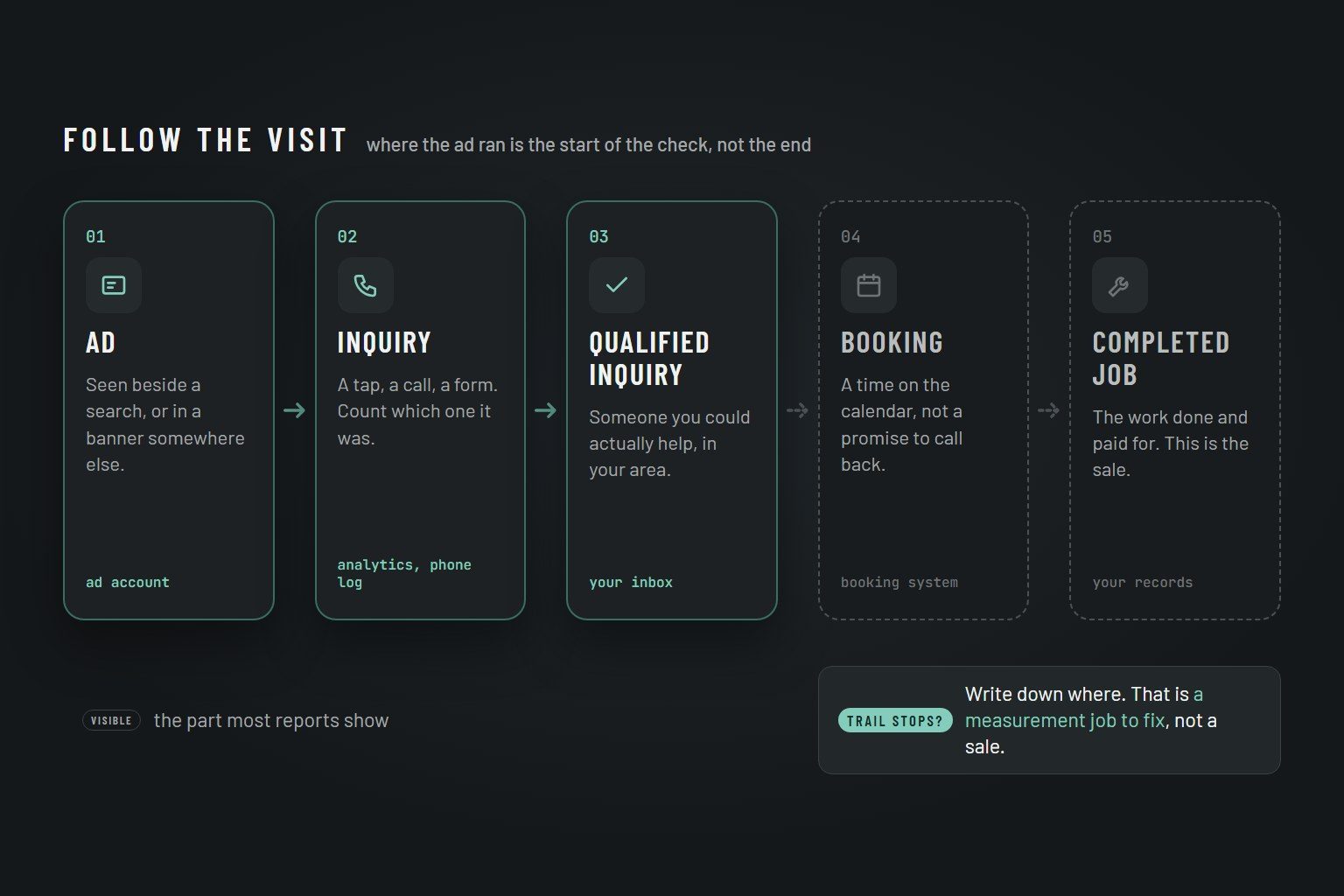
Where the ad appeared is the beginning of the check. What happened after the click is the part that matters to the business.
Start with the page the visitor reached. Someone looking for a particular service should be able to find that service, confirm that you cover their area, and take the next step without hunting through the site.
Then look at what your report calls a conversion.
Was it a tap on a phone number, a connected call, a submitted form, or a booked appointment? Those are different stages. A tap is useful to count, but it does not tell you whether anybody answered. A form tells you someone asked, but not whether the business could help them.
Keep following the trail as far as your records allow:
Ad → inquiry → qualified inquiry → booking → completed job.
You may not be able to connect every step yet. Write down where the trail stops. That is a measurement job to fix, not a reason to treat the last visible number as a sale.
Cheap clicks can make an expensive report.
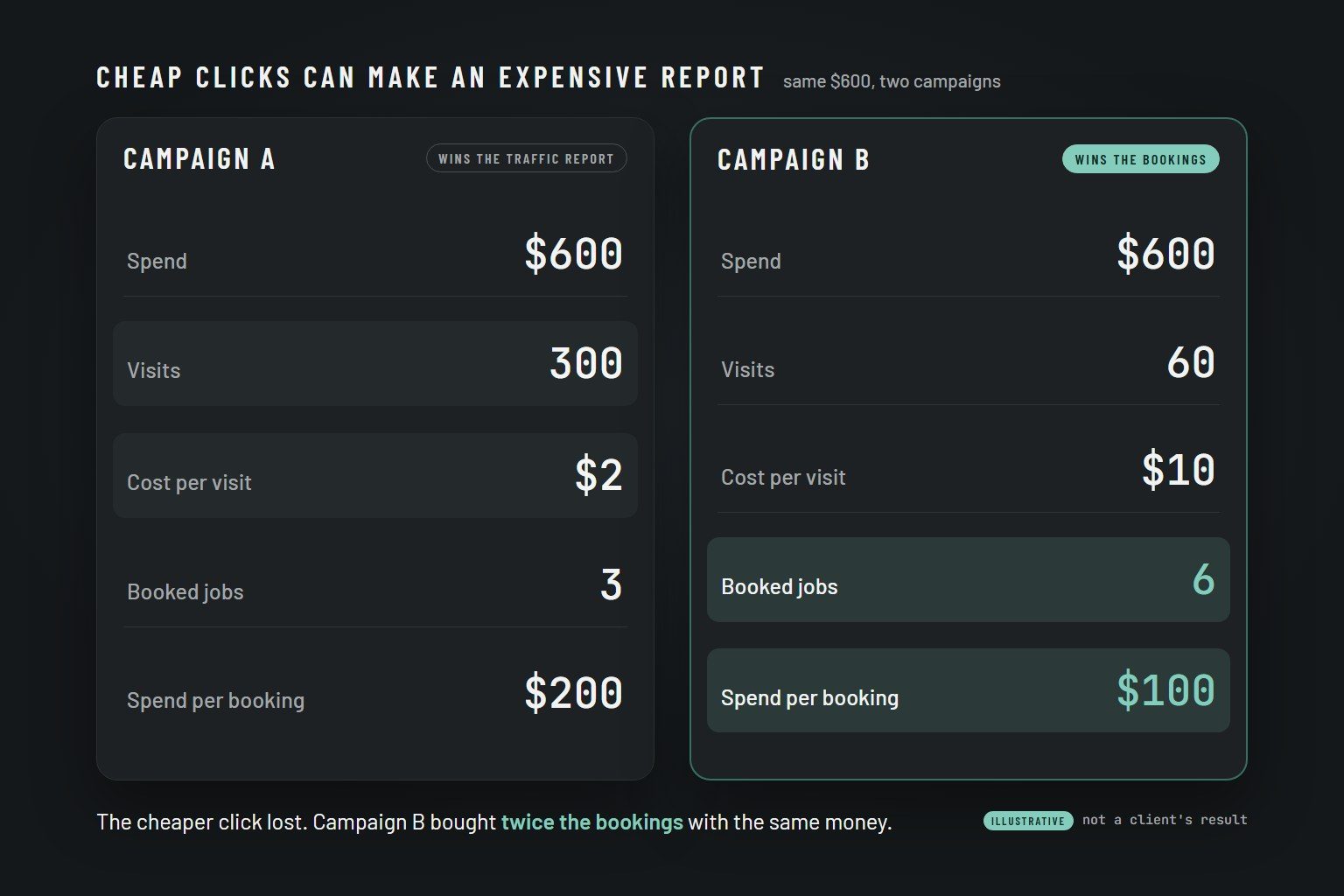
Here is an illustrative comparison, not the client’s result.
One campaign spends $600 and brings 300 visits. That is $2 a visit. It produces three booked jobs, or $200 in advertising spend per booking.
Another spends $600 and brings 60 visits. That is $10 a visit. It produces six booked jobs, or $100 per booking.
The first campaign wins the traffic report. The second buys twice as many bookings with the same money.
Even that comparison is unfinished. You still want to know which appointments happened, what the jobs were worth, and what remained after doing the work. Management fees belong in the full acquisition cost too.
But it is already a more useful conversation than celebrating the cheaper click.
What seven seconds tells you.
In our client’s account, the short visits were a reason to investigate. They were not the verdict.
A short visit might mean the wrong audience, an accidental click, a page that did not answer the question, or a measurement issue. Someone can also find a phone number quickly and leave to call.
That is why we look at placement, the landing page and the customer action together. None of those numbers should be asked to explain the whole campaign alone.
The mistake would have been to rewrite every ad before checking where it ran. Or to rebuild the website before checking who was arriving. Or to increase the budget because the visits looked inexpensive.
First establish what happened. Then decide what to change.
What to do this week.
Set aside twenty minutes with the person who runs your advertising.
- Open the account and select the last complete month.
- Split the spending by where the ads ran, as far as the reporting allows.
- Check the pages those ads sent people to, on your phone.
- Ask exactly what each reported conversion counts.
- Match a sample of inquiries to bookings or completed jobs in your own records.
Finish by writing down one change and the number you will use to judge it. If tracking is missing, that may be the first change. If the placement mix is different from what you intended, that may be the conversation.
You do not need to become an advertising specialist. You need to know what you bought, what happened next, and whether the result is worth buying again.