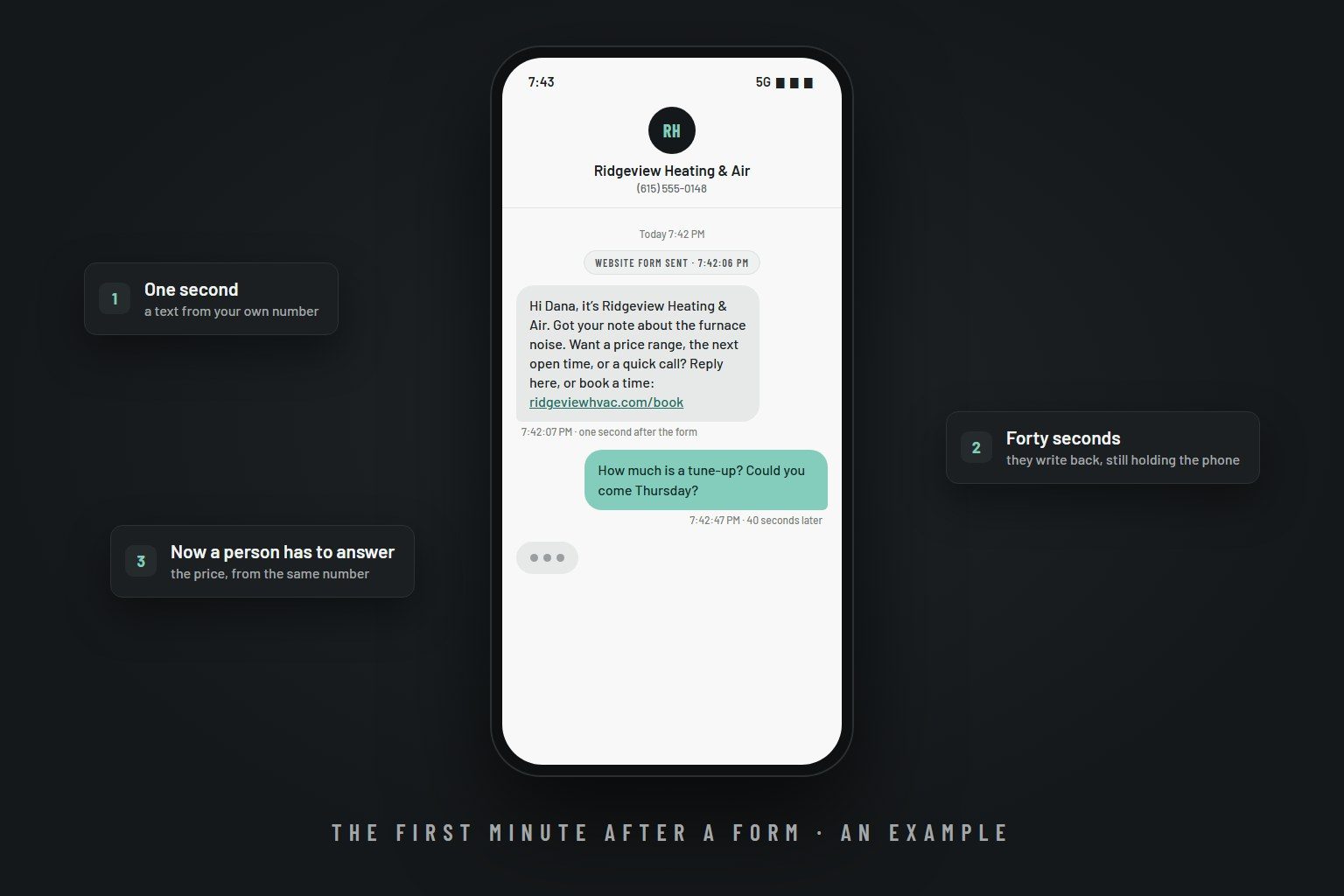
Somebody fills in the form on your website. Name, number, a question about price. They press Send, see a thank-you page and put the phone down. At most businesses, that’s where the inquiry waits: an email in an inbox somebody checks between jobs, while the person who asked moves on to the next business on the list.
None of that is new. In 2011, researchers writing in Harvard Business Review sent web inquiries to 2,241 U.S. companies. 37% answered within an hour. 23% never answered at all. Among the companies that did answer within 30 days, the average wait was 42 hours.
So we stopped guessing and counted our own. Southaven Homes, the Tennessee home builder our owners also run, has answered every inquiry automatically since September 13. Here’s what happens in the first minute, what nine real inquiries did with it, and the two places it broke.
What the first minute looks like.
Every inquiry goes through the same steps, whether it comes from the website form, a Facebook or Instagram lead ad, a missed call or a text from a number we don’t know. All of it happens in about a second.
- A text from the company’s own number. It reads like a person wrote it: what can I help with, the price, the open dates or the details, and if you’re working with an agent, we’re glad to loop them in. No pitch for a tour.
- An email about the home they asked about. Same tone, with a link to that home’s page.
- An alert on the owner’s phone. Who it is, where they came from and what they asked, word for word.
- A record in the CRM and on the email list. Nobody types anything in twice.
- Quiet hours. Texts only go out between 7 in the morning and 9 at night. An inquiry at 6:34 AM gets its email right away and its text at 8:00.
- One follow-up, a day later. If nobody has talked to them by then, they get one short text, and only one.
Nine inquiries, counted.
Since September 13, nine real inquiries have come in, not counting the fakes (more on those below): four from the website form, four from Facebook lead ads and one from Instagram. Here’s what the first minute did with them.
- Seven got their text within a second. One came in at 6:34 in the morning and waited, on purpose, until 8:00. One text didn’t go through; the email still did, a minute later.
- All nine got an email. Eight of them within two seconds.
- Four of the nine wrote back. Not to a person: to the automatic text.
- Three of those four wrote back within three minutes. One in 40 seconds, the other two in under three minutes. The fourth answered the next morning.
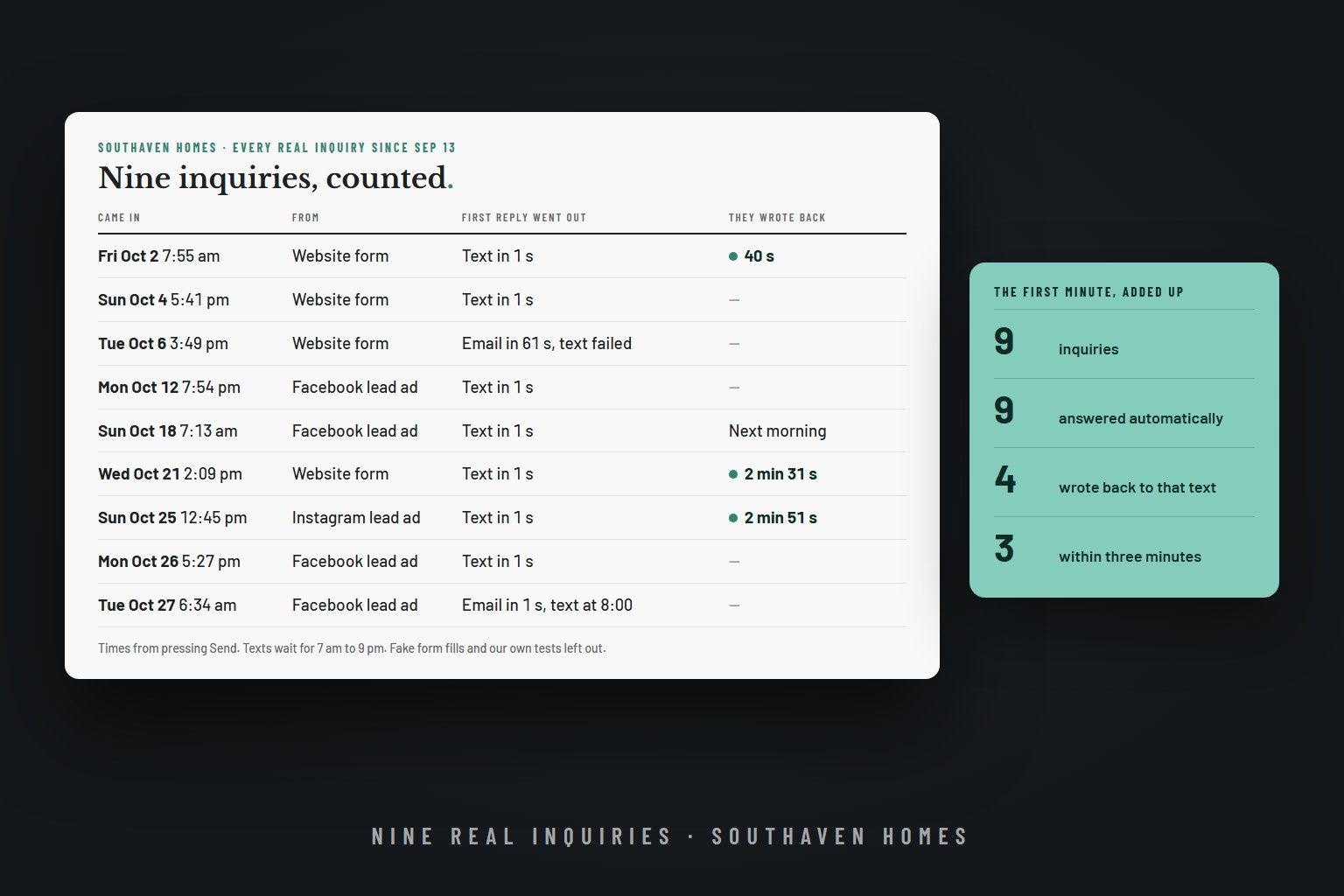
That last line is the one to read twice. The one-second text isn’t the win. The win is that three people answered it within three minutes, while they were still holding the phone. A fast automatic reply doesn’t close anything. It opens a conversation, and from that moment a person has to be there to have it.
That’s exactly where ours broke.
Where it broke: the hand-off.
On October 2, a buyer filled in the form a little before eight in the morning. The text reached her in a second. Forty seconds later she wrote back and asked for the price.
The owner saw the alert and answered from his own phone. But the system had no way to pass a text from his phone on to her, and nothing told him it hadn’t arrived. His answer was recorded and went nowhere. She got the price on the evening of October 4, two and a half days later, after he asked whether his replies were actually getting through.
The fix wasn’t faster software. It was one rule: every reply goes out from one place, on the same number the customer already has, and the dashboard shows who is waiting on us. A fast first text makes a slow second answer look worse, not better.
Where it broke: the bots.
Over Halloween weekend, six website inquiries came in that weren’t people. Random strings of capital and small letters where the name and the message should be, and an email address that was really a phone carrier’s text gateway.
The system did exactly what it was built to do. It answered all six within seconds, added them to the CRM and the email list, and started the welcome emails. Fast is only good when it’s fast at the right thing.
Now a filter looks at every website inquiry before anything sends. Anything that looks like a bot is logged and goes no further. There’s also a ceiling on how many texts can go out in an hour, so a flood of fake forms can’t turn into a flood of texts.
Test your own form in ten minutes.
You can find out what happens after your form without changing anything. Tonight, from a phone number and an email address your business won’t recognize:
- Fill in your own form at an awkward hour. 7:40 on a weeknight is a good one. Ask a real question, the one customers ask most, like a price or the next open date.
- Start a timer when you press Send. Write down the time of everything that comes back, and who wrote it: a system or a person.
- Read the first reply as the customer. Did it answer anything? Does it say what happens next, and when? Can you text it back?
- Write back to it. Ask the price. Then see how long a person takes to answer that, and whether the answer reaches you at all.
- Check where it went. Is the inquiry in your CRM or customer list without anyone typing it in? Could you say on Friday how many came in this week, from where, and how many got a real answer?
What to fix first.
Whatever the test turns up, fix it in this order.
- Nothing came back in five minutes. Start there. An instant reply, by text if you have their number and by email if you don’t. Put a line next to the phone field that says you’ll text them back, so the text is expected and they’ve agreed to it.
- Something came back but said nothing. Make it answer the question most people ask, and give them a way to book. We wrote about that in October: every automatic message you send is missing one line.
- A person answered late, or not at all. Fix the hand-off before anything else gets faster. One place to reply from, one number the customer already has, and someone who looks at the list of people waiting.
- You couldn’t say how many came in. Count them. Once a week: inquiries by source, how many got a real answer, and the typical time to that answer. If the number isn’t written down somewhere, nobody notices it getting worse.
Or have us look at yours.
If you’d rather have someone else look, ask for a free checkup. Tell us your business and your website, and within two business days we send back one page: what’s working, what’s leaking, and the three changes we’d make first. Your forms are on the list we check.
And if the answer is that nothing comes back at all, that’s the first fix we sell. The Lead Follow-Up Fix is a text back in under a minute with your booking link, one form or landing page put right, and tracking that counts it. It’s $1,500 to set up, $300 a month to keep answering, and live in two weeks.