Everyone is selling AI this year. The pitch is always some version of the same line: AI could save your team hours. Ask where, and you get a list of tools. Ask how many, and you get a shrug. Ask how anyone will know later whether the hours came back, and the call tends to end.
So some owners pay for an AI audit, hoping someone will finally do the counting. Most of the audits sold for under about $2,000 are a call plus a template: a questionnaire, a list of tools, no measurement. Nothing in your business was counted, so nothing in the report can be checked.
The one idea worth holding on to is this: an audit is worth what it measured. Anyone can recommend a tool. The value is in counting the hours where they happen, pricing each one, and checking later that they moved. Judge any audit, ours or anyone’s, by that. Then run a small one yourself this week with a printed sheet and a borrowed phone.
The five things a weak audit leaves out.
Hold any audit, or any proposal for one, against this list. A real one hands you all five.
- Hours measured, not guessed. A number from a meeting is an opinion. A real audit has your team log their repeat work for three working days.
- Reply times tested, not assumed. Someone contacts the business the way a customer would and times the first real answer.
- The arithmetic for every idea. Hours a week, what they’re worth at your own hourly cost, the setup cost, the monthly cost and the payback in weeks. An idea without a payback figure is a suggestion, not a finding.
- A “not yet” list. What AI should not touch in your business, plus a map of where your customer data lives and a short AI policy for your staff.
- A second measurement. The same log and the same test, run again a few months later, to check that the hours actually came back.
Count the hours with a three-day time log.
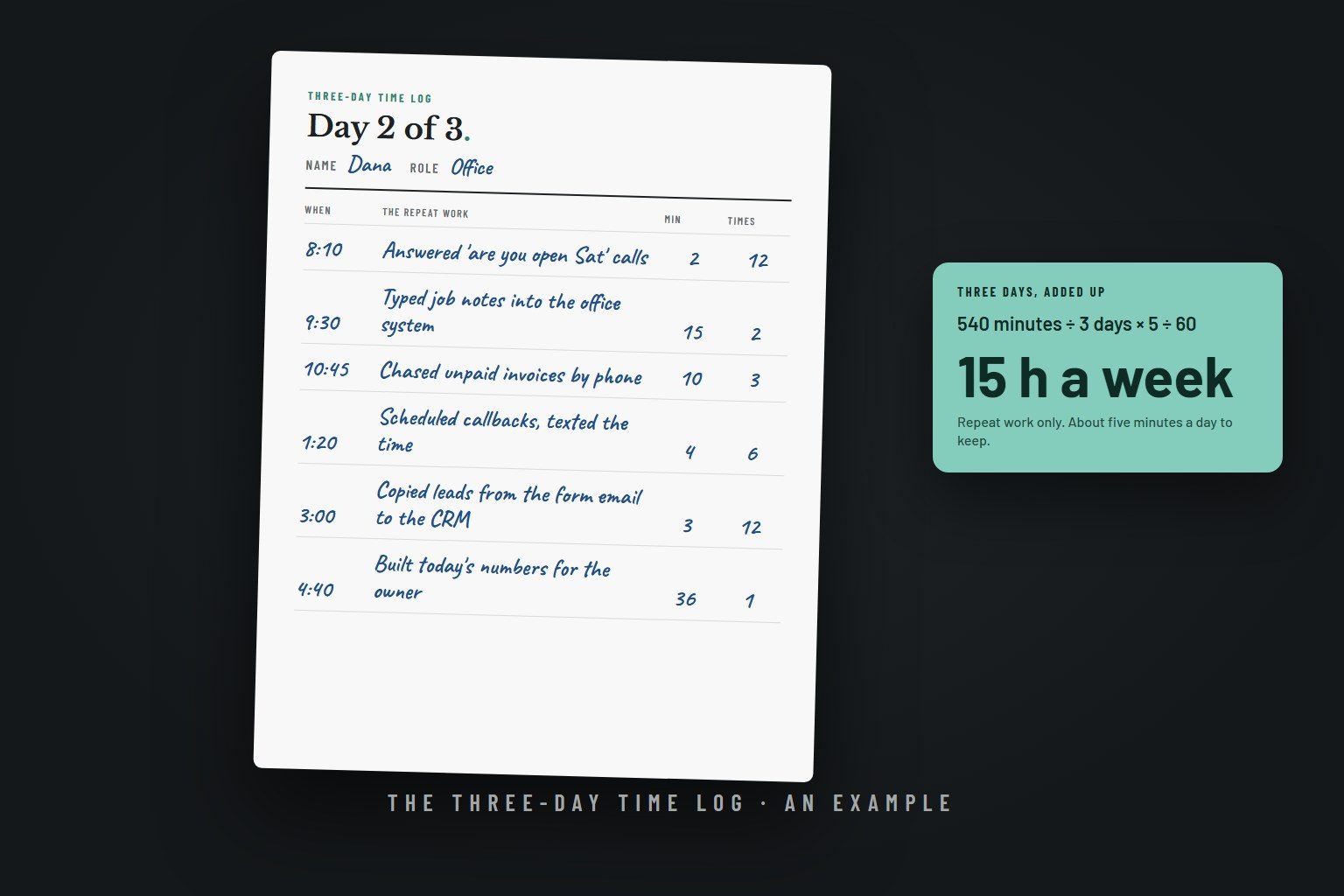
For three working days, everyone who does repeat work writes down what they did, how long it took and how many times. About five minutes at the end of the day covers it. Typing the same job into two systems. Answering the same questions about hours. Chasing signatures. Building the schedule.
Count repeat work only. The one-off mess on Tuesday afternoon stays off the sheet. Tell the team plainly what this is: a count of the work, not a grade on the people doing it. If anyone reads it as a performance review, the sheet comes back tidy and wrong.
Then turn minutes into hours a week. For example, say the front desk logs 540 minutes of answering the same phone and email questions over three days. Divide by 3 for a day: 180 minutes. Multiply by 5 for a working week: 900 minutes. Divide by 60: 15 hours a week, from one line on one sheet.
Do every line the same way and sort from most hours to fewest. The top three are where to look first. That sorted list is already more than a template audit hands you.
Time your own replies with a secret shop.
Hours are half the picture. The other half is how long a customer waits for an answer. You can test that in three days too.
- Pick six ways in. Your website form, a phone call, a missed call where you hang up before voicemail, a text, a Facebook message, and whatever your Google listing offers.
- Use a number they won’t know. Borrow a friend’s phone and email, or use a second line. If the team knows it’s you, you’re testing their manners, not the system.
- Spread them out. Over three days, some in business hours and some after, the way real customers show up.
- Time the first real reply. A “we got your message” auto-reply doesn’t stop the clock. A reply that answers the question or offers a real time does. No reply in 48 hours counts as 48 hours.
- Close each one politely. Never book a real job. Thank them, say your plans changed, and let it go.
Sort the six times from shortest to longest and average the third and fourth. That’s the median. For example: 4 minutes, 22 minutes, 1 hour 50 minutes, 3 hours 10 minutes, 19 hours, and one with no reply, which counts as 48 hours. The middle two are 110 and 190 minutes, so the median first reply is 150 minutes, or 2 hours 30 minutes.
Why the median? The plain average of those six is about 12 hours, dragged up by one dead channel, and it describes none of them. The median is what a typical customer waits. The slowest line is the door to fix first. And like the time log, it measures the system, not a person.
Put a price on every hour before you buy anything.
Start with what an hour costs you for whoever does the work, payroll taxes and benefits included. An hour a week is worth that cost times 52 over a year.
An example, in round numbers. At $30 an hour, 3 hours a week is 3 x $30 x 52 = $4,680 a year. Say a missed-call text-back would take those 3 hours off the front desk, for $900 to set up and $75 a month.
Turn the monthly cost into a weekly one: $75 x 12 / 52 = $17.31 a week. The hours are worth 3 x $30 = $90 a week. Less the running cost, the net is $90 — $17.31 = $72.69 a week. Payback is the setup cost divided by that: $900 / $72.69 = about 12.4 weeks, a little under three months.
Do that for every idea. The fastest paybacks go first.
One honest caveat. Freed hours aren’t cash. That $4,680 only shows up if the 3 hours go somewhere that earns, like calling back open estimates or answering the next lead faster. Decide where the hours go before you buy the tool.
Write down what AI should not do.
A real audit says no, too. Some work should stay with a person for now: setting prices, handling complaints, safety calls, decisions about people, and anything clinical or legal. Put those on a “not yet” list and hand it to whoever sets up your tools.
Two short pages belong next to it. A data map: which systems hold customer names, numbers and payment details, and which of them a new tool may read. And a staff AI policy: what the team may paste into a chatbot, what they may not, and who to ask.
Measure again, or it didn’t happen.
Two or three months after the changes go in, run the same log and the same six contacts again. Put the date on the calendar now. If the top lines came down and the median reply got shorter, the change earned its keep. If not, you know which tool to stop paying for.
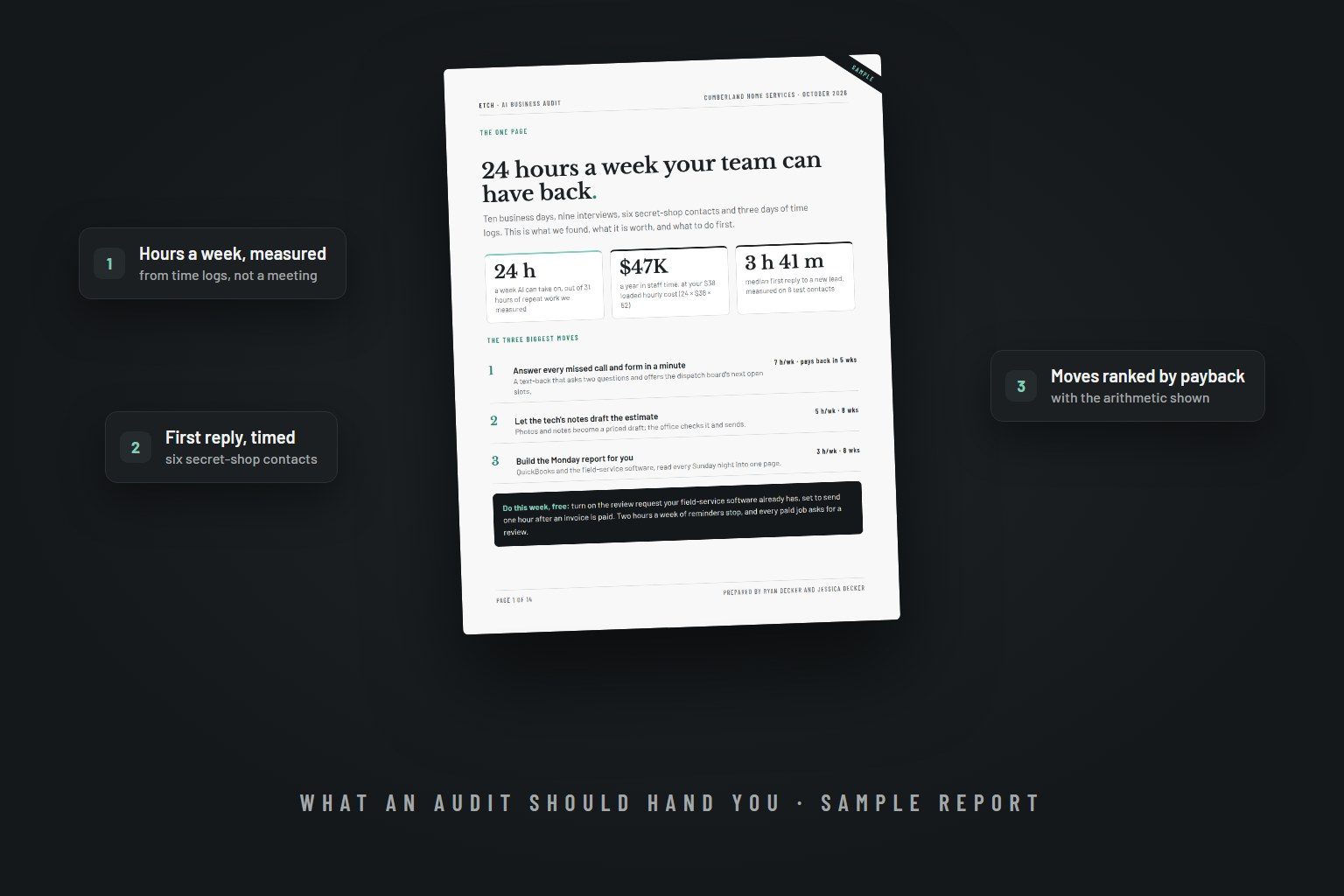
A real audit’s first page shows all of that at a glance. On page one of a sample report we built for a made-up home-services company, AI could take on 24 of the 31 hours of repeat work measured each week. At a $38 loaded hourly cost, that’s 24 x $38 x 52 = $47,424, about $47K a year. The median first reply to a new lead, across six test contacts, was 3 hours 41 minutes. Then come three moves, ranked by payback.
Our own AI Business Audit works that way: measured, ranked by payback, and guaranteed. It finds the hours a week it promises, or the fee comes back. It starts with a $500 Quick Scan. But nothing above needs us.
Start the log tomorrow morning.
Don’t try to do all five this week. Do one. Tonight, make a sheet with four columns: task, minutes, times, notes. Hand it out tomorrow morning and ask everyone to give it five minutes before they leave, for three working days. Then do the division. You’ll have your own hours a week, worked out on paper.
If you’d like a rough number before you start, the free AI Hours Scorecard asks ten plain questions, takes about three minutes and shows its estimate on screen, no email needed.