
Most small businesses post in bursts. Three posts in a good week, a flurry before a sale, then nothing for a month because the work got busy. Customers do not remember the burst. They remember who was there when they finally needed someone, and that is usually whoever they had seen lately, doing something useful.
That is the whole job of a content plan: to keep you in front of people in the long stretch before they need you. Not to go viral, and not to post every day. To be there, steadily, with something worth a glance.
Take a made-up landscaping company heading into its quiet months. Below is a plan that keeps it in front of its customers until spring, and it fits in about two hours a week.
Most of your customers do not need you today.
In 2021 John Dawes of the Ehrenberg-Bass Institute set out what is now called the 95:5 rule. He was writing about business buyers: if a company changes its bank or its law firm about once every five years, then in any given quarter only about 5 percent of those companies are shopping. The other 95 percent will buy later, and when they do, they start with the names they already know. He offered it as a rule of thumb, not a law.
Local customers work the same way, on their own clock. A family needs a landscaper when they move in, when the old one retires or when the yard finally gets away from them. You cannot know which week that will be. You can make sure that when it comes, yours is the name they have seen all year.
That is what staying in front means. It is a memory, not a campaign.
Start with one idea a week, not seven.
The plans that die are the ambitious ones: a post every day, a video every week, a newsletter and a blog, all starting Monday. By February the calendar is empty and the owner feels worse than before they started.
Start smaller. One useful idea a week, written once, then cut into the shapes each place wants. One idea a week is fifty a year. That is more than most of your competitors will manage, and every one of them points back to you.
Where the ideas come from.
You already have a year of ideas. They arrive by phone. For two weeks, keep a notepad by the phone and write down every question a customer asks: on a call, at the door, in a text, in a review. Each question is a week’s idea, because if one person asked it, a hundred more wondered.
Write the answers the way you would give them at the door: plain words, a real example from a real job, and a price range if you are comfortable sharing one. That is what people are typing into the search bar.
Then add the calendar. Every trade has a season, and the season tells you what people are about to need. For the made-up landscaper, the next eight weeks might look like this. Six answers, a look behind the scenes, and one offer at the end.
- Week 1: Should I leave the leaves on the lawn over winter?
- Week 2: Is winter a good time to plant a tree?
- Week 3: What the crew does in December, with photos from the week.
- Week 4: What to do with the Christmas tree after the holidays.
- Week 5: How to keep salt from killing the grass along the driveway.
- Week 6: When should crabgrass preventer go down? Answered before the rush.
- Week 7: How do I get the lawn ready for spring before it greens up?
- Week 8: Spring cleanup spots for March are open. The one offer of the season.
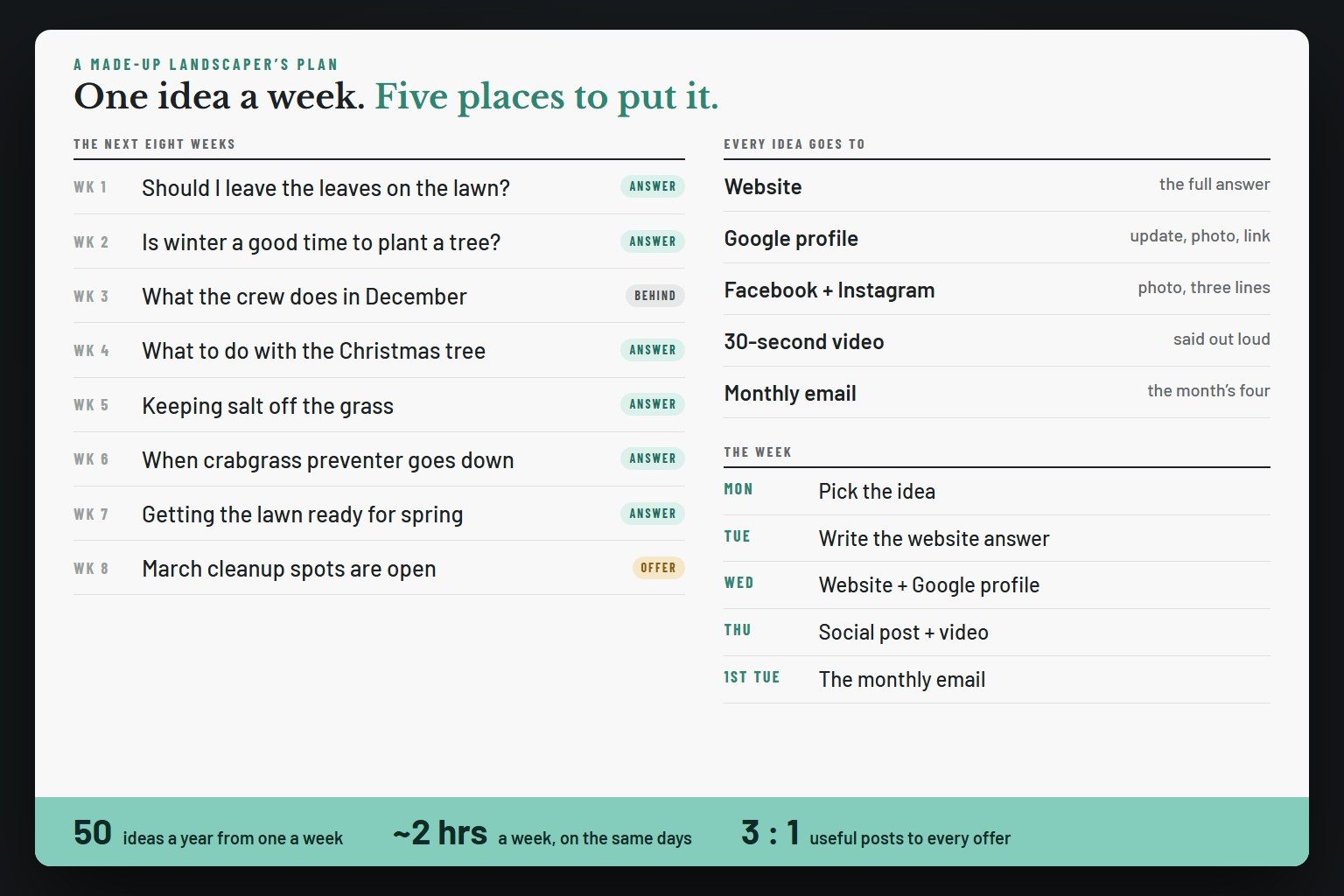
One idea, five places.
Write the idea once, as a short page on your website: three hundred words that answer the question plainly, with a photo from a real job. Then cut it down for everywhere else. Each place wants a different shape, but none of them needs a new idea.
The website comes first for a reason. Most posts are buried in the feed within a day or two. A page on your own site keeps answering the question for years, and it belongs to you, not to a platform that can change its rules.
- Your website: the full answer, on a page of its own. It is the piece Google and the AI search tools can find, and the one every other post links back to.
- Your Google Business Profile: a short update with the photo and a link. It shows up where people are already looking for you.
- Facebook and Instagram: one post with the photo and the answer in three lines.
- A 30-second video: you, on your phone, saying the answer out loud. Real beats polished.
- Your monthly email: the month’s four ideas in one note to past customers, sent on the same day each month.
The week, on one page.
A plan you can keep has a fixed shape, so nobody has to decide what to do each week. About two hours, spread across the week:
- Monday: pick the week’s idea from the list. Five minutes.
- Tuesday: write the website answer. About an hour.
- Wednesday: put it on the website and the Google profile.
- Thursday: the Facebook and Instagram post, and the 30-second video.
- The first Tuesday of the month: the email, carrying last month’s four.
What keeps it going.
Most plans fail on rhythm, not ideas. A few rules keep this one alive.
- Same day, every week. A page that posts once a week for a year earns more trust than one that posts every day for a month and goes quiet.
- Useful first. For every offer, three things that help. People forgive one ad when the last three posts taught them something.
- Real over polished. Your crew, your trucks, your jobs. A phone photo of real work beats the nicest stock picture.
- Bad weeks happen. Skip the video, not the idea. The website answer is the part that keeps working after the week is over.
- Count conversations, not likes. Ask every new customer how they heard about you, and write it down when someone mentions a post, a video or the email.
This is how we plan our own: one Ledger entry a week, and the week’s posts come out of it.
If you would rather hand it over, our social media service plans the month, makes it and posts it, and you approve it all in one sitting. Or start with the free checkup, a one-page look at how customers find you today.