
AI employees are for sale everywhere this year. An AI receptionist, an AI sales rep, an AI office manager, each with a friendly name and a monthly price. Some of them are good. Most of the ones that disappoint were hired the way nobody would hire a person: with no job description.
We set these up for a living, and we run them in our own businesses. The ones that work all began the same way, with one page written before any software was switched on. Here is what goes on that page, how to pick the first job and what the first week should look like.
What an AI employee actually is.
Strip away the name and an AI employee is software with one job. It waits for something to happen, like a new lead, a finished job or Monday morning, and it does the next step without being asked.
Some of that work is not artificial intelligence at all. Texting a new lead back within one second is plain automation, and that is a strength: it does the same right thing every time. The AI part is the reading and the writing, such as working out what an email is asking, drafting a reply or turning a week of numbers into a paragraph. A good setup uses each where it fits, and whoever sells it to you should be able to say which is which.
What it is not is a person. It knows nothing about your business beyond what you wrote down for it, and it should never be left to make something up.
Pick the job before you pick the tool.
The first job to fill is rarely the most exciting one. It is the one that passes three tests.
- It happens the same way every time. Replying to a new lead, asking for a review, sending a reminder.
- It depends on someone remembering. If the work gets skipped on busy days, software will do it better than a person, because software does not have busy days.
- Speed or steadiness is worth money. A lead answered in a minute, a quote followed up the next day, a report that arrives every Monday.
The jobs that fail these tests are the ones built on judgment: pricing an unusual job, calming an upset customer, deciding who to hire. Keep those with people.
The six jobs most businesses fill first.
In a small business the same handful of jobs pass all three tests, so they are the ones we set up most.
- The lead responder: texts and emails every new lead back within a minute and tells you who to call.
- The follow-up clerk: sends one friendly nudge when a lead or a quote goes quiet for a day.
- The review asker: asks for a review the day after the job and drafts a reply to each one for your yes.
- The front desk: reads incoming email and forms, sorts them and sends each one to the right person.
- The weekly reporter: gathers the numbers from every platform and writes them up every Monday.
- The content assistant: drafts posts and emails from new jobs or products, waiting for your yes.
The job description, on one page.
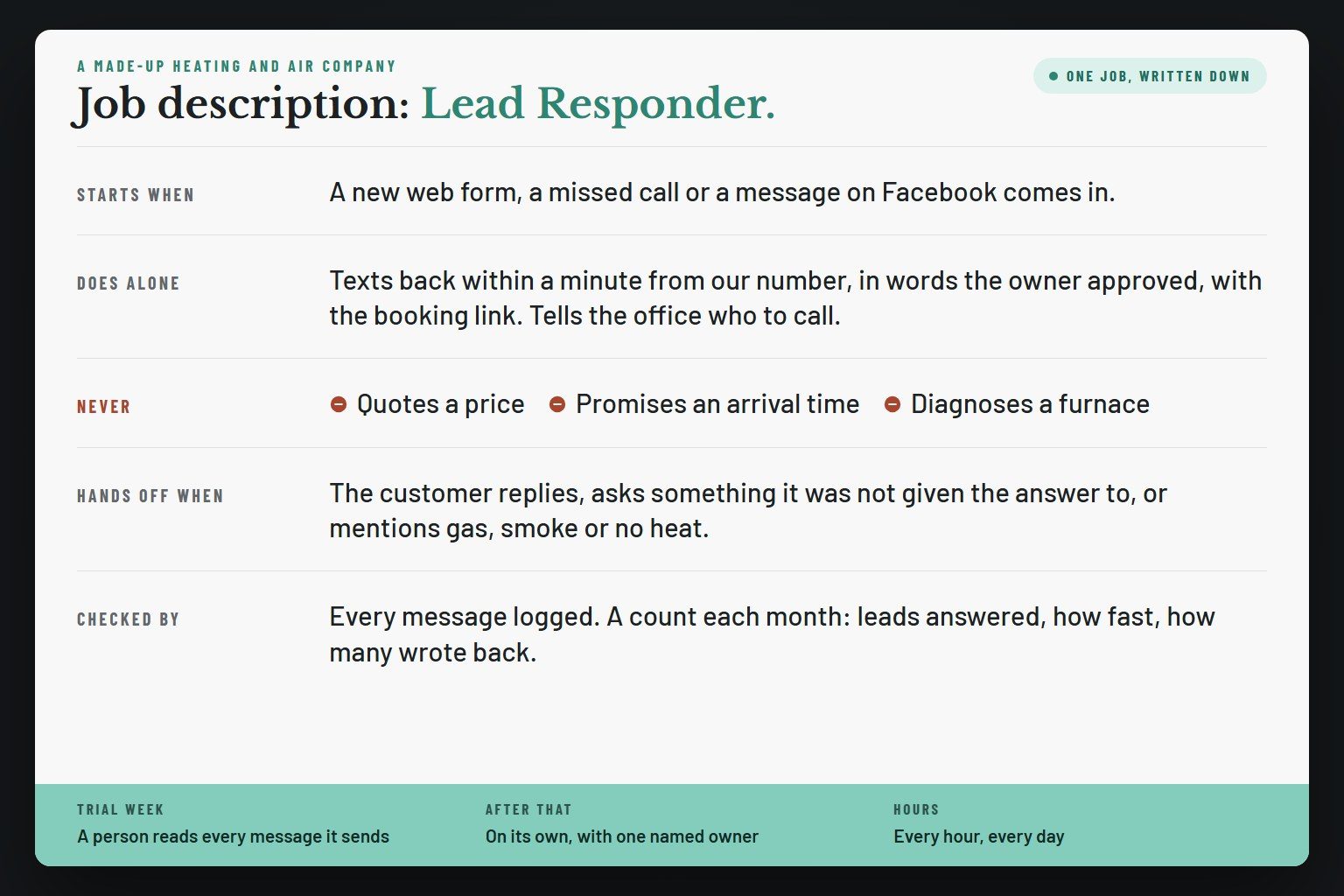
Take a made-up heating and air company that wants its first AI employee to answer new leads. Before anything is built, the owner and the builder fill in one page. It has five lines.
- What starts the work: a new web form, a missed call or a message on Facebook.
- What it does alone: texts back within a minute from the company’s number, in words the owner approved, with the booking link, and tells the office who to call.
- What it never does: quote a price, promise an arrival time or diagnose a furnace.
- When it hands off: the moment the customer replies, asks something it was not given the answer to, or mentions gas, smoke or no heat. A person takes it from there.
- How you check it: every message is logged, and each month you get a count of leads answered, how fast and how many wrote back.
That page is the whole design. If you cannot fill in a line, the tool is not the problem yet. And if a seller cannot tell you what their product would put on the third and fourth lines, keep looking.
Give it a trial week.
No new hire works alone on the first day. For the first week, an AI employee should run on real leads while a person reads everything it sends. You are looking for three things.
- Wrong words. A reply that is correct but does not sound like you. Fix the wording.
- Wrong moments. A text at midnight, or a nudge to someone who already booked. Fix the rules.
- Missed handoffs. A question it answered that it should have passed to a person. This is the one that matters most.
Only when a week goes by with nothing to fix does it work on its own. Even then, somebody owns it. One named person gets the alerts and reads the monthly count.
What ours did in October.
We tested this on ourselves first. Southaven Homes, the home builder we own, has had a lead responder at work since September. Its job description is close to the one above: text every new buyer lead back from our number, in wording we approved, and tell us who to call.
In October nine buyer leads came in. All nine got a text back, half of them within one second, and six of the nine wrote back. Nobody had to remember, and nobody was pulled off a job site to do it. Every conversation after that first reply was ours, which is how we want it.
Nine is a small number, and we would not build a forecast on it. What it shows is the part that matters: none of the nine waited.
Six questions for anyone selling you one.
Whether you build it yourself, buy it off a shelf or hire a studio like ours, the same questions sort the good setups from the rest.
- Which parts are AI, and which are plain automation?
- Who writes what it says to my customers, and can I read every word first?
- What will it never do, and where is that written down?
- Who is told when it gets stuck, and how fast?
- Whose accounts does it run in? If I leave, do the phone number, the messages and the customer list stay with me?
- What will I see each month that tells me it is working?
An AI employee is not a way to avoid hiring people. It is a way to stop losing the small, steady jobs that fall through on busy days, so the people you have can spend their time with customers.
If you want one on the job, our Hire an AI employee page lists the six we set up most, how hiring works and what it costs. Not sure which job to fill first? The AI business audit measures where your hours go and ranks the jobs by payback.